Showing posts with label 1940 The Grapes of Wrath. Show all posts

Wednesday, September 25, 2013

Kata’s Progress – The 1940’s

Haunting, Beautiful. Still Relevant. Slow Moving. Hard to Get Into. Timeless. Ponderable. Boring. 

Above are some of the words that I repeatedly used in my blog to describe the Pulitzer winning books. With perhaps the exception of A Bell for Adano, the books require a fair amount of discipline and patience to read. To get a true sense of these books, most need to be read slowly.

Tales of the South Pacific marks a change in the Pulitzer winners. The award goes from being called the Pulitzer Prize for the Novel to being called the Pulitzer Prize for Fiction. Tales of the South Pacific is not so much a novel as a series of short stories. Needless to say, many of the books during the 1940’s were about World War II. As with many of the earlier Pulitzer winners, racism is often discussed in these stories.

Thursday, October 23, 2008

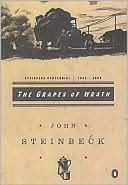
The Grapes of Wrath by John Steinbeck - Tammy's review

Title: The Grapes of Wrath

Author: John Steinbeck

First Published: 1939

No. of Pages: 464

Synopsis (from B&N): Although it follows the movement of thousands of men and women and the transformation of an entire nation, The Grapes of Wrath is also the story of one Oklahoma farm family, the Joads, who are driven off their homestead and forced to travel west to the promised land of California. Out of their trials and their repeated collisions against the hard realities of an America divided into Haves and Have-Nots, Steinbeck created a drama that is intensely human yet majestic in its scale and moral vision, elemental yet plainspoken, tragic but ultimately stirring in its insistence on human dignity.

Comments and Critique: John Steinbeck was a master storyteller. He had the ability to get you interested in the story and to hold your interest for page after page. The story of the Joads is heartbreaking but at the same time shows mankind’s strength of character in the face of overwhelming odds, especially in the character of Ma Joad. Without doubt, she was my favorite – she showed resilience through poverty, hunger, and death, all the while presenting a brave face to the outside world and trying everything she could to keep her family together.

It’s always been difficult for me to imagine what it was truly like to live through the Great Depression. The only family I have that was alive then is my grandmother. She’s told me a little about her life growing up on a central Florida farm as the 2nd oldest of 8 children, but has never wanted to talk much in detail about the experience. I’ve noticed that many elderly people do that, they either don't discuss it or they downplay the hardships that you know they suffered, often with the comment that, “We didn’t have much, but then neither did anyone else.” It’s almost like it wasn’t as bad because so many were suffering right alongside. That was also a theme in this book. Steinbeck really focused on the interaction of the migrants and showed how they looked out for one another, shared their food and lodgings, and provided moral support.

My copy of the book has extensive commentary, which provides a good look at the historical and social context of the story. My next step is to watch the movie version, which I’ve always heard is excellent, and see how it compares to the book.

Interesting facts:: John Steinbeck lived with an Oklahoma family and travelled with them to California as research for this book. The Grapes of Wrath won the Pulitzer Prize for fiction in 1940. John Steinbeck was awarded the Nobel Prize for Literature in 1962.

Would You Recommend This Book to Others: Yes

Wednesday, August 15, 2007

The Grapes of Wrath - Laura's Review

The Grapes of Wrath
John Steinbeck
502 pages

First sentence: To the red country and part of the gray country of Oklahoma, the last rains came gently, and they did not cut the scarred earth.

Reflections: What a fantastic way to begin the year's reading. I know this is a classic, and there would be little debate about its place in American literature. I probably don't have any unique commentary on this work. But I was surprised at how much I was "sucked in" to this book, and how much it stayed with me during the times I was not reading.

The powerful themes in this book, for me, were 1) the desperation of the migrant families, and 2) the intense drive to keep families together. Steinbeck is able to convey the sense of desperation so vividly, both through the Joad's experiences and through the chapters describing the world around them: the car salesmen, the people who buy off farmers' assets, the growers/canners in California, the effect of the heavy rain. And then Ma Joad's intensity around keeping the family intact throughout, and her ultimate failure to do so, is just heartbreaking. I can't imagine what it felt like, in an age without email and mobile telephones, to have one of your children go off in search of a better life on their own.

I know the ending is meant to cast a ray of hope, but I was left wondering what would happen next to these poor people, stranded in a barn in a flood with no money, no food, and no hopes.Another thread running through my mind as I read was about society's apparent need to find a lower class who can be mistreated. In this book, and in that time period, it was the migrant workers. Today, we have found immigrants to do similar labor and their living conditions in many cases are not much better than the Joad's. There are many other groups who are also marginalized. Why is this? And why is it so difficult to eradicate this pattern of hate and discrimination?

Original review can be found here.

Monday, August 13, 2007

The Grapes of Wrath - Wendy's Review

In the souls of the people the grapes of wrath are filling and growing heavy, growing heavy for the vintage. -From the Grapes of Wrath, page 349-

In John Steinbeck's most renown novel, The Grapes of Wrath, Tom Joad gets released from prison and returns to a home decimated by technology:

"Le's look in the house. She's all pushed out a shape. Something knocked the hell out of her." They walked slowly toward the sagging house. Two of the supports of the porch roof were pushed out so that the roof flopped down on one end. And the house-corner was crushed in. Through a maze of splintered wood the room at the corner was visible. The front door hung open inward, and a low strong gate across the front door hung outward on leather hinges. -From The Grapes of Wrath, page 41-

Thus, this sweeping novel takes us on a journey with the Joad family as they join thousands of migrant workers seeking a better life in the West. Steinbeck fills his novel with homespun characters and the bitter reality of life in the 1930s during the Great Dust Bowl migration.

This novel has been banned, burned and challenged since its publication in 1939 for reasons such as "vulgar language" and "sexual references." In addition, Steinbeck angered many for his honest depiction of the political and economic landscape in the 1930s, where large landowners artificially inflated the cost of goods by destroying surpluses and drove down wages by luring thousands of workers to a California that could not support their numbers.

Steinbeck is a genius at characterization and using symbolism to draw images for the reader. Tom Joad represents all the survivors who joined together and found strength in numbers; who fought back when the future looked the bleakest; who rose up to fight for their families; and who
refused to lose dignity even while camping in Hoovervilles.

The women who people this novel are wonderful - strong, authentic, the glue that holds the family together. Ma Joad's tough, realistic character drives the novel and tugs at the reader's heartstrings:

She seemed to know, to accept, to welcome her position, the citadel of the family, the strong place that could not be taken. And since old Tom and the children could not know hurt or fear unless she acknowledged hurt and fear, she had practiced denying them in herself. And since, when a joyful thing happened, they looked to see whether joy was on her, it was her habit to build up laughter out of inadequate materials. But better than joy was calm. Imperturbability could be depended upon. And from her great and humble position in the family she had taken dignity and a clean calm beauty. From her position as healer, her hands had grown sure and cool and quiet; from her position as arbiter she had become as remote and faultless in judgment as a goddess. She seemed to know that if she swayed the family shook, and if she ever really deeply wavered or despaired the family would fall, the family will to function would be gone. - From The Grapes of Wrath, page 74-

Beautiful descriptions of a desolate country; use of symbolism; amazing characterization; compelling dialogue; a vivid and honest portrayal of the family; and an ending which will shock…are all reasons why Steinbeck's The Grapes of Wrath is one of the few great American novels. A must read. The Joad family will stick with the reader long after the final page has been turned.

Highly recommended. Rated 5/5. To read my original review, go here.


Following are some of my favorite passages from the novel.

About the countryside:
66 is the path of a people in flight, refugees from dust and shrinking land, from the thunder of tractors and shrinking ownership, from the desert's slow northward invasion, from the twisting winds that howl up out of Texas, from the floods that bring no richness to the land and steal what little richness is there. From all of these the people are in flight, and they come into 66 from the tributary side roads, from the wagon tracks and the rutted country roads. 66 is the mother road, the road of flight. -page 118-

About Granma:
Behind him hobbled Granma, who had survived only because she was as mean as her husband. She had held her own with a shrill ferocious religiosity that was a lecherous and as savage as anything Grampa could offer. Once, after a meeting, while she was still speaking in tongue, she fired both barrels of a shotgun at her husband, ripping one of his buttocks nearly off, and after that he admired her and did not try to torture her as children torture bugs. As she walked she hiked her Mother Hubbard up to her knees, and she bleated her shrill terrible war cry: "Pu-raise Gawd fur victory." -page 78-

About symbolism (the turtle):
He came over the grass leaving a beaten trail behind him, and the hill, which was the highway embankment, reared up ahead of him. For a moment he stopped, his head held high. He blinked and looked up and down. At last he started to climb the embankment. -page 14-15-

About community:
In the evening a strange thing happened: the twenty families became one family, the children were the children of all. The loss of home became one loss, and the golden time in the West was a dream. And it might be that a sick child threw despair into the hearts of twenty families, of a hundred people; that a birth there in a tent kept a hundred people quiet and awestruck through the night and filled a hundred people with the birth-joy in the morning. A family which the night before had been lost and fearful might search its goods to find a present for a new baby. -page 193-