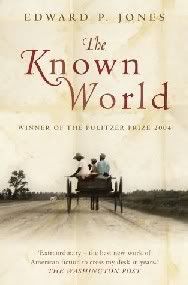
Set in the 1840’s in the fictional Manchester County, Virginia, The Known World is the story of Henry Towsend, a former slave who became a farmer and a slave-owner himself. The story is told in a non-linear way, with several flashbacks and flash-forwards. The main focus of the book are the events leading up to and following Henry’s death, but there are also episodes that take place several years before (concerning Henry’s life as a slave, for example, and how his parents saved money for years to buy his freedom) or after, and episodes that deal with many other characters – the other inhabitants of Manchester County, slaves and freemen alike. After Henry’s death, his widow Caldonia, an educated free woman of colour, is left in charge of the plantation, but very soon things begin to fall apart.
The Known World is a stunning book. It’s beautifully written, it’s subtle, it’s very moving, and it’s complex. It’s a book in which several tragic things happen, but it moves beyond being a parade of tragedies. It deals with race and gender, but it also goes beyond that. I’d say it’s the best book about slavery I’ve read so far, except it’s not so much a book about slavery as it is a book about several people caught up in a system whose full consequences are not easy to grasp.
It’s not easy to capture all the emotional complexities that slavery must have involved, but Edward P. Jones seems to have done just that. And I say “seems” because I’m still not sure that any of us can really grasp all that must have been involved. Looking back now, from the safety of historical distance, it’s easy to forget that these were people doing such things to one another, and so of course that all kinds of feelings would have been involved. Feelings that weren’t easy to label, feelings that weren’t always what they were supposed to be. From the part of masters and slaves alike.
Then there’s of course the question, how could an ex-slave ever become a slave owner? This book doesn’t really answer it (is there an answer?) but it deals with it in a manner that never becomes simplistic:
"Henry had always said that he wanted to be a better master than any white man he had ever known. He did not understand that the kind of world he wanted to create was doomed before he had even spoken the first syllable of the word master."The week before I started The Known World I had to read a few chapters from James Walvin’s Black Ivory: A History of British Slavery for a project, and then I ended up reading the whole thing because the book was too good, too well-written and too informative, for me to put it down. I found that reading The Known World and Black Ivory side by side increased my understanding and appreciation of both books. While one gave me the facts, the other gave me the human realities behind them. The actual human lives. I want to share with you a passage from Black Ivory that perfectly describes what we see in The Known World:
"Overseers and drivers in the Southern cotton fields were presumable no more or less inhuman, kind, sadistic or tolerant than their counterparts in the previous century in the Caribbean. It was the system which debased and corrupted. Doubtless it attracted its fair share of low life; of men, like men on the slave ships, not noted by their humanity or feelings. But even the most considerate of men generally found themselves debased by slavery. In so tainted a system, it was difficult for anyone in a position of authority not to be dragged down into slavery's corrosive mire. Whatever the management's ideal (and there were plenty of whites who sought to pursue it), the reality was much coarser, much cruder, less human."The Known World is an honest, haunting and thought-provoking look at slavery and all that it involves. Edward P. Jones created a world in which everything has multiple shades of grey. This is a book that will stay with me for a long time, the kind of book that the more I think about, the more I like. Highly recommended.


 The Known World

 )
 The Known World by Edward P. Jones has not only won the Pulitzer Prize for Fiction, but also the NBCC Award and the International IMPAC Dublin Literary Award.