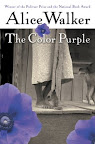
 This is one of those books that I love so much that I am hesitant about trying to write about it for fear of trivializing it in some way. I reread this book in February, but was unable to even approach writing about it until I decided to just do one of these questionnaires so that I can be walked through the process.
 Title and author of book? The Color Purple by Alice Walker
What led you to pick up this book? I've read it before, probably twice, maybe three times. This year, I saw the movie for the first time, which made me want to reread the novel.
Give a brief summary of the plot: The main character, Celie, grows up poor in an abusive household. In fact, it seems like everyone she knows is abusive or abused, so it seems normal to her -- this is probably a result of the crushing despair of poverty. She's married off young to a man who continues the pattern of abuse. He's also in love with another woman, a woman who becomes Celie's friend.
What did you like most about the book? For me, the most moving part of the story is Celie's separation from her sister; my favorite part of the book has something to do with this separation, but to talk about that would be a huge spoiler. I also really like the letter structure of the novel, and I like the use of dialect in this book, even though dialect is usually distracting for me. And I really love the way Celie grows into a level of strength that allows her to start standing up for herself somewhat.
What did you like least?There isn't anything I could really say I dislike about this book, but some scenes are disturbing. For me, the most difficult scene is the one in which a friend of Celie's is beaten and imprisoned for trying to stand up for herself.
What did you think of the writing style? The writing is amazing. As I said above, it's epistolary and uses dialect. Some parts are written in standard English, and those beautiful passages only serve to highlight the simplicity of Celie's uneducated writing and speech. But don't get me wrong; Celie's words are also beautiful. It's amazing to me how Walker manages to write in these two different styles, and make both of them so full of insight.
What did you think of the main character?: I can remember that upon my first reading of this book, I felt frustrated with Celie. She tolerated such terrible treatment, and I was angry with her. I think I have a better understanding of human nature now, so I realize that Celie is a person who has spent her entire life so beaten down -- and not just by individuals, but by society as a whole -- that it's impossible that she could have lived her early years of adulthood in any other way. During this reading of the novel, I was able to notice Celie's gradual strengthening, and rather than resenting Shug's presence in Celie's life at all, I was able to see how she helped Celie grow. I was also able, this time, to appreciate the way women in the book support each other and give each other a sense of community in a world that completely marginalized women of their era, race, and socioeconomic class. Not that the men of their era, race and socioeconomic class fared much better.
Any other particularly interesting characters?Most of the words of wisdom are given to Shug and to Nettie. I think that Walker gave her own voice to those characters at times. They are both amazingly strong and they both overcome terrible circumstances through a combination of luck, talent and introspection.
If this book has been made into a movie, and if you’ve seen the movie, compare the book to the movie. If you've only seen the movie, if you liked it, you should really treat yourself to the book. The movie leaves out so much.
Share a quote from the book: I'll share two, so that you can see the contrasts mentioned above.
The years have come and gone without a single word from you. Only the sky above us do we hold in common. I look at it often, as if, somehow, reflected from its immensities, I will one day find myself gazing into your eyes. Your dear, large, clean and beautiful eyes.
And this is Celie, speaking of her stepson (Harpo) and her husband (Harpo's daddy).
Harpo no better at fighting his daddy back than me. Every day his daddy get up, sit on the porch, look out at nothing. Sometime look at the trees out front the house. Look at a butterfly if it light on the rail. Drink a little water in the day. A little wine in the evening. But mostly never move.
Harpo complain bout all the plowing we have to do.
His daddy say, You gonna do it.
Harpo nearly as big as his daddy. He strong in body but weak in will. He scared.
Me and him out in the field all day. Us sweat, chopping and plowing. I'm roasted coffee bean color now. He black as the inside of a chimney. His eyes be sad and thoughtful. His face begin to look like a woman's face.
Cross-posted in my blog.


