- 1932 The Good Earth - Pearl S. Buck
- 1937 Gone With The Wind - Margaret Mitchell
- 1961 To Kill A Mockingbird - Harper Lee
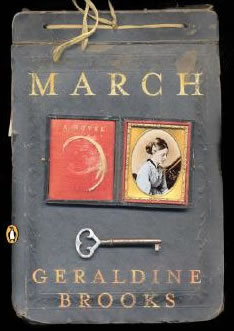
- 2006 March - Geraldine Brooks
Monday, February 25, 2013
Hobby Buku's Progress [ Just In a Year Reading ]
Sunday, October 19, 2008
March by Geraldine Brooks
Friday, May 2, 2008
2006 - March
While March focuses a little bit on Marmee, the majority of this book is about Mr. March (called March), the father of the girls, who, in part one of Alcott’s novel, is away fighting in the Civil War. In this novel, we read his letters to Marmee—and then we read the truth of what is happening to him in the South. March writes “I promised her that I would write something every day…I never promised I would write the truth” (page 4).
In a fascinating contrast to the girls’ failures in Little Women, March’s failings are huge to him; he cannot solve them in a chapter or even by the end of the book. As Little Women delves into the little problems of teenage girls, March delves into the larger problems of an adult before and during the civil war: slavery, death, violence and war, betrayal, marital and extramarital relationships, and confusion about one’s role in the world and in a family. To me, it is an intriguing contrast to the goody-goody world of Little Women.
Geraldine Brooks has thoroughly researched both the civil war and the life of Louisa May Alcott’s father, Bronson Alcott, for many of the philosophies and characteristics of Mr. March. Since Alcott herself based Little Women on her own experience, basing Mr. March on Alcott’s father seemed very appropriate. I love a well-researched novel, especially historical fiction, and this certainly was well-researched.
I also loved the concept of fleshing out a character that otherwise wasn’t noticed. I know I never gave a thought to Mr. March when I first read Little Women. Only on rereading Little Women now, knowing that I’d read March next, did I realize how little attention is given to him.
Note: I’d recommend reading Little Women (at least part one) before approaching March. They complement each other nicely.
Originally posted here. Visit me on Rebecca Reads.
Friday, April 11, 2008
2006: March by Geraldine Brooks
By Geraldine Brooks
Completed April 11, 2008
What happens to a family when a husband and father goes to war? Many books explore this question, and one of the most famous is Little Women by Louisa May Alcott. But what about the husband and father - how is he impacted by the war during and after the battles are fought? For these questions, we can rely on the fantastic storytelling of Geraldine Brooks and her Pulitzer-winning March.
In this novel, we learn about Mr. March who was away during Little Women, which offered a creative canvas for Brooks’ story. March, an active abolitionist, enlisted as an army chaplain at the beginning of the Civil War. His service took many twists and turns before he ended up on a Yankee-controlled plantation, where he taught former slaves how to read, write and do math. While there, he fell victim to “the fever” and later a bullet, which forced him to a hospital in Washington, D.C.
Readers of the original Little Women may envision Jo’s father to be a docile, patient, kind-hearted man who made more good decisions than bad. Furthermore, one might expect Marmee March to be the typical antebellum wife and mother – silent, obedient and sinless. Brooks took a different path with these characterizations, however, in March. March was, in fact, very fallible whose idealism cost him (and his family) their fortune and almost March’s life. Marmee March was an impulsive hot head, constrained by the societal and marital norms of her time. Together, their marriage had secrets and miscommunications, which sounded very “normal” to me. Other readers may prefer Alcott’s original depictions, and if you’re one, I recommend skipping March because you will feel frustrated by the Marches.
While this story explored slave conditions and the horrors of the Civil War, the war’s toll on March left the biggest impression. He emerged hopeless and depressed. I think of war veterans now and realize that nothing has changed. We need to do a better job in helping our service men and women when they return to civilian life – whether we agree with the war or not. To me, that’s the biggest lesson I learned from March. The affects of war are timeless, and if you are interested in the social and psychological impacts of war on men, women and children, I would recommend March to you. (
(cross-posted from my blog)
Friday, January 25, 2008
March - Geraldine Brooks
Author: Geraldine Brooks
Country: USA
Year: 2005
Rating: 5 of 5
Pages: 280
First sentence: This is what I write to her: The clouds tonight embossed the sky.
I always hesitate to pick up books that are based on characters from classics, especially a classic as beloved as Lousia May Alcott's Little Women. March, by Geraldine Brooks, tells the previously untold story of the absent father. Fortunately for readers, it does not disappoint.
In this beautifully written novel, we get to experience life from Mr. March's perspective. Told largely through a series of flashbacks after he enlists as a Chaplain for the Union Army, we hear about March's childhood, his life as a young peddler in the pre-Civil War South, how he makes his fortune, and how he loses it. We learn about his dreams, hopes, failures, hopeless idealism, and indiscretions. The writing is exquisite, and sounds like an authentic voice from the past.
Brooks' detailed research of the Civil War era is evident, and I learned about aspects of the war that I had not previously known about, such as what happened to runaway slaves that crossed the federal lines during the war. Referred to as contraband, they worked on plantations taken over by Northerners for a small wage.
Like Alcott, Geraldine Brooks draws largely from Bronson Alcott's life for inspiration. Yet, this is a novel that easily stands on its own. Lovers of Little Women may not like the freedom that Brooks took with the characters, which were portrayed as an ideal family. Through this novel, they are a bit more realistic, and seen in a different light. It is a book about the harsh realities of life; she does not cast Mr. March in the role of a hero.
I promised her that I would write something every day, and I find myself turning to this obligation when my mind is most troubled. For it is as if she were here with me for a moment, her calming hand resting lightly upon my shoulder. Yet I am thankful she is not here, to see what I must see, to know what I am come to know. And with this thought I exculpate my censorship: I never promised I would write the truth. (p.4)
Tuesday, January 22, 2008
March - Laura's Review
Geraldine Brooks
273 pages
"Then what, pray, is the point?" His voice was a dry, soft rattle, like a breeze through a bough of dead leaves.
"The point is the effort. That you, believing what you believed -- what you sincerely believed, including the commandment 'thou shalt not kill' -- acted upon it. To believe, to act, and to have events confound you--I grant you, that is hard to bear. But to believe, and not to act ... That is what would have been reprehensible." (p. 258)
Louisa May Alcott's classic, Little Women, describes a year in the life of a mother and her daughters, while her husband is away serving in the Union Army. The father is absent for most of the book. In March, Geraldine Brooks brings the father's character to life and tells the story of that year from his point of view. Mr. March is a clergyman, so while he does not experience combat directly, he ministers to the wounded and dying. Initially, after a harrowing battle scene, he finds himself on a plantation that he had first encountered as a young itinerant peddler. Old relationships are rekindled, and he is reassigned to another regiment, and transported to a Southern estate under Union occupation. The slaves on this estate were under Union protection, and Mr. March was to provide them with the basics of an education. The novel's pace picks up at this point, and becomes considerably more violent as the horrors of war are revealed. March eventually lands in hospital, is visited by his wife Marmee, and returns home for Christmas just as he does in Little Women. In March we gain much more intimate knowledge of how the war scarred him, both physically and mentally, and how it affected his relationship with Marmee.
I was hooked on this story from page 1. Scenes from the American Civil War were interspersed with narrative describing how Mr. March came to be married to Marmee, their participation in the Underground Railroad, and his motivation for joining the Union army. He wrote letters from the front but, reluctant to burden his family with his daily horrors, he masked the truth. Marmee, on the other hand. felt lonely and resentful: "I am not alone in this. I only let him do to me what men have ever done to women: march off to empty glory and hollow acclaim and leave us behind to pick up the pieces." (p. 211) Their reunion was touched with both sadness and hope.In letting her imagination run around the edges of Little Women, Brooks has written a memorable novel. Highly recommended. (
My original review can be found here.
Saturday, August 18, 2007
2006: March by Geraldine Brooks -- Dewey's review
Written Sunday, May 28th, 2006 9:50amTitle and author of book? March by Geraldine Brooks
Fiction or non-fiction? Genre? Historical fiction, imitative fiction, parallel fiction.
What led you to pick up this book? I read Year of Wonders and loved it, so I was keeping an eye out for this writer to publish a new book.
Summarize the plot, but don't give away the ending! In Louisa May Alcott's Little Women, Mr March is absent; he's serving in Civil War as an army chaplain. Little Women is narrated by his daughter, Jo. This is Mr March's story, taking place in the same time that Little Women unfolds up north.
He starts off as an army chaplain, but then he's sent to teach freed slaves to read. About 2/3 of the way through the book, at the point in Little Women when Marmee is summoned because Mr March is in the hospital, the point of view changes from first person (Mr March) to first person (Marmee). Once he's better, the point of view reverts back to Mr March.
The story of Mr. March's earlier life is told in flashbacks, while he's at war.
What did you like most about the book? This is probably my favorite book of the past five years, so I loved nearly everything. I loved the writing style, the characters, and the way it tied in so well with Bronson Alcott's life and Louisa May Alcott's novel. I loved how absolutely nothing was black-and-white, cut-and-dried. Everything was filled with ambiguity.
Have you read any other books by this author? What did you think of those books? Year of Wonders was incredibly good. I haven't read anything else by Brooks, but I've put all her other books in my wishlist.
What did you think of the main character? The main character was done really well. Brooks clearly researched Bronson Alcott's life thoroughly. In the middle of reading, I started to suspect she'd based Mr March on Alcott, since Jo was based on Louisa May Alcott, so I read up on him, and it was obvious that he's the inspiration for Mr March. Then I read an interview with her which verified my assumptions. She'd even used his exact words in some of his letters, and used Thoreau's and Emerson's exact words, but taking them out of context. For example, she takes the passage about Flint's pond from Walden and has Thoreau say that to Mr March.
Any other particularly interesting characters? Marmee! She's fleshed out into a real person in this book, whereas she played a rather peripheral role in Little Women. First you learn about her from Mr March's point of view, and then, later, when she has her say, it's hilarious the way her perceptions of events are completely different from her husband's.
Share a quote from the book: "If there is one class of person I have never quite trusted, it is a man who knows no doubt."
Share a favorite scene from the book. In Little Women it's hinted that the Marches used to be wealthy, but now they're poor. And the only indication of how they lost their money was that they lent money to an untrustworthy friend and never got it back.
In this book, that story is fleshed out, using what the author knew of the Alcott family. We learn that the Marches financially backed John Brown and lost everything.
One of the best parts of that subplot is that March offers financial assistance to Brown because he thinks Marmee admires Brown, and he wants Marmee to admire him that much. But in reality, Marmee thinks he's an idiot for backing Brown (at least to the extent of losing all their money).
What about the ending? I loved the ending. March is back home (in Little Women he comes home at Christmas) but he's wracked with guilt over his experiences in the Civil War, and he's not sure how he's going to live with himself. He decides he'll just have to live with himself day by day, trying to come to terms with his guilt while at the same time trying to be a role model for his girls. I love that there wasn't some pat "The love of family will fix everything" ending, but at the same time, there was hope.
Monday, August 13, 2007
March - Wendy's Review
I simply ask you to see that there is only one thing to do when we fall, and that is to get up, and go on with the life that is set in front of us, and try to do the good of which our hands are capable for the people who come in our way. -From March, page 268-In Louisa May Alcott's novel Little Women, one character - Mr. March - is absent and only exists in the reader's imagination. Geraldine Brooks re-imagines this character within the pages of March. Part history and part love story, this novel is a carefully wrought tale of one man's journey through America's most devastating war.
The novel is told primarily through the voice of Mr. March, sometimes through his letters home to his wife and daughters, sometimes through flashbacks. But the most powerful sections of the story are the portrayals of violence and loss.
The narrative tension and fine story development of March sticks with the reader long after the final page has been turned.
Recommended; rated 4/5
To read my original review, go here.
Wednesday, August 8, 2007
2006 - March - 3M's Review
Marchby Geraldine Brooks
2005, 273 pp.
2006 Pulitzer Prize
Rating: 3.5
I really wanted to love this book, but I ended up only liking most of it and despising parts of it.
March tells the story of Mr. March. You know, the father in Little Women by Louisa May Alcott. We didn't know much about him from Little Women, and really, maybe we were better off that way than reading Brooks' reimagined version. I did not like her "version" of Marmee, either.
Some of this book is extremely well done. The civil war scenes and the descriptions of the plight of the slaves were excellent. The characters of Mr. and Mrs. March were not. Although they both do have their admirable moments, their "reputation" is severely tarnished in this book and neither is very likable at all. Their "conflicts" felt like they were from a soap opera. I am not one who cares for soap operas and certainly do not wish to feel like I'm "reading" one in a Pulitzer Prize winning book.
I recommend it solely to those who like to read "prize winners" or to those who are Little Women enthusiasts. But be warned: you may wish you did not have these new visions of the Marches competing with the original.