Showing posts with label 2005 Gilead. Show all posts

Sunday, July 31, 2011

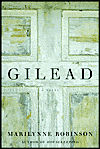
Gilead by Marilynne Robinson (2005)

Title:  Gilead
Author:  Marilynne Robinson
Published:  2004, Farrar, Straus, and Giroux
Genre:  Literary Fiction
Accolades:  2005 - Pulitzer Prize for Fiction, 2004 - National Book Critics Circle Award for Fiction, 2006 - long list Orange Prize for Fiction

76-year-old Congregationalist Minister John Ames is dying of a heart condition.  Still capable of preaching and mentally sharp he has decided to write a letter - a journal of his thoughts - to his young son to explain the family's history, who he is, and what he believes.  Set in Gilead, Iowa in 1956 this quiet, profound book is the story of a life and a faith that can move mountains if only it can forgive.

There are certain books that as soon as you read the first two or three pages you know that it is special - that it will change you somehow - maybe not lightning bolt jolts, but small, subtle movements near your heart.  Gilead was that book for me.  Gilead begins with John Ames counting the blessings of his life and expressing the joy of having found love and having a child in the twilight of his years.

" I'm writing this in part to tell you that if you ever wonder what you've done in your life, and everyone does wonder sooner or later, you have been God's grace to me, a miracle, something more than a miracle." page 52

What simple words written or spoken that could be life-changing - some one's salvation - maybe we need to say them to those we love.  As we read on though we discover when the "prodigal son" of a life-long friend comes back to town that John Ames has yet to give the greatest miracle of all - forgiveness. Though Ames is a minister he still struggles with a human soul and Robinson deftly and beautifully describes his torment and his epiphany.

In the bible Gilead means hill of testimony and that is what the book Gilead is for John Ames his testimony of a well-lived life. 

My Rating: 5 out of 5

Monday, April 26, 2010

Laura's Review - Gilead


I'm writing this in part to tell you that if you ever wonder what you've done in your life, and everyone does wonder sooner or later, you have been God's grace to me, a miracle, something more than a miracle. You may not remember me very well at all, and it may seem to you to be no great thing to have been the good child of an old man in a shabby little town you will no doubt leave behind. If only I had the words to tell you. (p. 52)
John Ames is a Congregationalist minister living in Gilead, a small Iowa town. Late in life, he was blessed with a wife and son. Now, aware that his heart is failing, he begins writing a long letter to his son, to be read when the son comes of age. Gilead is that letter. In it Ames tells his life story, shares hopes and dreams for his wife and son, and explores matters of faith.

Ames was himself the son of a preacher. Through his writings he tries to come to terms with his strained relationship with his father, now long dead. He mourns his first wife and child, both of whom died too soon, and he rejoices in having found love at an advanced age. But there is one matter that weighs heavily on Ames, and his letter serves as a sort of catharsis.

Ames' best friend is a Presbyterian minister, Robert Boughton. The two have spent years leading Gilead's faithful, and developed a deep and lasting friendship. Boughton had several children; Jack, the black sheep of the family, was named after Ames. When Jack Boughton returns to Gilead after a long absence, Ames must face long-suppressed emotion and conflict, and accept his inability to control events after he has passed on.

This is a magnificent novel. The pace is leisurely and conversational, initially masquerading as an amusing portrait of small-town religious life, full of little details like the bizarre Jello salad concoctions served at church suppers. But Gilead is so much more: it is a celebration of life, love, friendship, fathers, sons, and forgiveness.

Marilynne Robinson followed Gilead with Home, which presents the same story from the Boughton family's perspective. Each book stands on its own, and is beautiful and moving. But the whole is greater than the sum of its parts. The richness and depth of this story become apparent on reading both books. These are not to be missed.


Read my review of Home

My original review can be found here.

Monday, June 15, 2009

2005 Prize Winner - Gilead (Marilynne Robinson) - Review by LegalMist

This review was originally posted on my other blog, LegalMist. Please read my spoiler alert before reading this review. Please feel free to comment either here, or at this review on my LegalMist blog.

Gilead (Marilynne Robinson, 2005) is written as a letter from an old man, John Ames, a Reverend in a country church, to his young son. The Reverend married a younger woman late in life, and is now afraid he will die before his son matures, so he writes a book-length letter to his son, in a conversational style, talking about current happenings and past events in the history of his family and the town he lives in; his thoughts on life, God, religion, spiritual matters, other people, historical events, and the meaning of things; and about his love for the boy and his mother. The book jumps back and forth between past and present, and can feel a little disjointed at times. This made it seem authentic, in a sense - random stories and thoughts, just as you would write if you were writing a long series of letters, rather than editing a book - but can make it hard to follow if you're not paying close attention.

The book is well-written in the sense that the author describes things with such detail you can really see them there in front of you (and yet the details seem to flow naturally and are beautifully evocative, rather than mind-numbingly thorough). I was entranced by some of the spiritual discussions and by the Reverend's firm insistence that life itself - our human existence on Earth - is a thing of beauty to be treasured despite any difficulties or earthly "ugliness," rather than as a struggle to be endured until we can rush to "heaven" or some other more beautiful / spiritual place after death. This viewpoint certainly differs from that of some other religious leaders and was refreshing in that sense.

I loved the author's beautifully stated observations about American life and religion, human nature, and the beauty of the world. The Reverend's musings and stories are interesting, amusing, and thought-provoking, and the "letter" itself contains enough interesting events and describes interesting persons well enough that you actually get a sense of their character....

but...

maybe it's my fault because when I started out, I tried to read this book an hour at a time while taking my kids to piano class or gymnastics or whatever, sitting and waiting... and with rather constant interruptions, so it was slow going (probably about 15 minutes of actual reading time for each hour I sat with the book). And so I thought the "letter" was ok, but I kept wondering why Reverend Ames seemed to so dislike and distrust his namesake / godson, who is his best friend's son? I kept thinking I missed something along the way, and so I kept turning back the pages and skimming prior chapters, trying to find what I had missed. This led to a very disjointed reading of the book.

Finally, I had to set it aside. I just felt too confused and frustrated by it.

I picked it up again two months later, when I had a chunk of free time, and started from the beginning, determined this time not to miss the critical piece of information about why the Reverend so disliked his godson, and promising myself that if I wasn't enjoying the book this time, I'd just give it up and start a different one.

This time, I read it in a few hours over the course of two relatively distraction-free days and actually liked it. (This seems to be a trend for me with these Pulitzer winners - I don't quite "get it" the first time through - it takes a second reading for me to pick up on the themes and facts that make the book interesting and/or "prize-worthy." Apparently my "English Lit" skills are a little rusty.)

As it turns out, we don't learn why the Reverend so dislikes his godson until very near the end of the book. I wasn't as frustrated this time, though, since I knew I hadn't missed anything, it just wasn't there yet.

I won't spoil the fun stuff by talking about the amusing stories in the book. I will say I found the end touching, and not in a fairy-tale happy ending sort of way (and the following may spoil the end for those of you who haven't read it).

The book explored the biblical and spiritual themes of the prodigal son, God's love despite human sins, redemption, reconciliation, forgiveness, pride, and spiritual growth. The book also deals, at a more mundane / earthly level, with stories of abolitionists and racial tension, recognizing that many religious leaders were also leaders in the abolitionist movement and that the abolitionists were, by necessity, a rather unlawful bunch. For example, the Reverend's grandfather, also a Reverend and an abolitionist, is painted as a very fallible and strong-willed character, a very religious man but with quirks and sins and human fallibility. And the book explores the sometimes strained relationship between fathers and sons - including Reverend Ames's relationship with his father, and his father's relationship with his father (the Reverend's abolitionist grandfather).

These themes are brought together in the character of the young John Ames. We eventually learn that he fathered a child when he was young and left town in shame, after refusing to marry the young mother or to support the child. His father, Reverend Ames's best friend (and a Reverend in a church of a different denomination), loves his son unconditionally in spite of this major human failing, and yearns for his son's return. Reverend Ames, the younger Ames's Godfather, does not understand this unconditional love, despite his attempts to apply his biblical understanding of the story of the prodigal son. He tries to understand, but he just doesn't, which is obvious because he so dislikes the younger John Ames and mistrusts him so thoroughly when he returns to visit his father.

Near the end of the book, the younger John Ames tells the old Reverend Ames that he has a son about the same age as the Reverend's son, and tells him about his desire and efforts to marry the mother of his son whom he loves but has been unable to marry (because in the 1950's interracial marriage was not allowed), and Reverend Ames comes to see the beauty, strength, human frailty, honor, and worthiness of his Godson, and comes to accept him despite his past sins and failures. There is a scene in which Reverend Ames formally blesses his Godson before his Godson leaves (probably never to return), and you can almost feel the years of misunderstanding and mistrust and doubts and frustration falling away, replaced by great love and compassion and understanding.

Meanwhile, the young John Ames's own father, who has always loved him despite his sins (the "prodigal son" theme), never learns of the redeeming qualities the senior Ames discovers near the end of the book. There is a suggestion that, if he knew of his son's struggle to marry the woman he loves despite the racial issues and of his mixed-race grandson, he might in fact be less accepting or loving than he has been - an interesting contrast with the Godfather / Godson relationship, and an interesting comment on the concept of "unconditional love" being doled out disproportionately to those who don't "deserve" it.

I was somewhat disappointed that the story of how the Reverend came to marry his much-younger, ethnic wife was not explored or explained further. I would have liked to have seen the racial themes explored more thoroughly, and also would have liked more insight into these characters. Why was the wife so drawn to the Reverend? Why was the Reverend so drawn to her? (We get a little information about this second question, but not much at all about why she insisted that he marry her). And although the Reverend muses some about his son and tosses in a couple of stories about the child, we never get much of a sense of the kid's personality. Perhaps exploring these areas in more detail would have made the book "too long." But I think it would have made the book more interesting and thus would have been worthwhile. As it is, I felt the description of the relationship between the Reverend and his wife was rather "flat," and I kept thinking the kid would have loved to read more about how his father and mother met and fell in love, instead of reading strange stories of abolitionists and this younger "John Ames" that he may never see again.

All in all, this was not my favorite book ever, although I liked it. I won't be telling all my friends they should rush out and read it. But I won't tell them not to, either. If you have the time to read it over the course of a couple of days so you can keep the events and people straight in your head and not feel as if you're missing something, and if you enjoy rather random musings about God, religion, and life; and character studies; and life-vignettes, then by all means, go for it. If you're looking for an action-adventure story or a romance or even a more thoroughly drawn historical fiction type novel, move along down the bookstore aisles and find something else.

If any of you have read it, I'd love to hear your thoughts in the comments section.

.

Sunday, October 19, 2008

Gilead by Marilynne Robinson (Audiobook)

Read in November 2007:
I found this novel uplifting and deeply thoughtful. John Ames, a preacher in 1956 Gilead, Iowa, knows he is nearing the end of his life. The novel is a letter to his almost 7-year-old son who will not know or remember much of his father. He writes of his family's history, his thoughts on life and religion, and tells of some difficult experiences he has had learning forgiveness. This is one of the few audiobooks I've listened to that I loved the voice of the narrator. This was a good one to listen to, and reading it around Thanksgiving was appropriate, because you see the things that are important to John Ames at the end of his life. I checked out the books so I could quote some of my favorite passages, but there were just too many. It's far from a plot-driven book, but I see it as one that can sit on your nightstand and be read a little bit each night.

Wednesday, June 18, 2008

Gilead review by Athena

This Pulitizer prize winning book by Marilynne Robinson is the definition of modern literary novels. The novel does not have much in the way of plot. It is an epistolary novel of an old man writing for his very young son about his life. It is extremely introspective and beautifully written. I do not think it is for everyone, but I could relate to it because I am like the character and the style. It is not to say that I think as the character does all the time, but I certainly do understand why they mean with lines such as this:
I don't know why solitude would be a balm for loneliness, but that is how it always was for me in those days, (p 18-9 hardcover)

It is the kind of book I can see myself rereading because it reminds me of so many things of myself and my inner world. It is introspective and reflective, spiritual and pensive:
Our dream of life will end as dreams do end, abruptly and completely, when the sun rises, when the light comes. And we will think, All that fear and all that grief were about nothing. But that cannot be true. I can't believe we will forget our sorrows altogether. That would mean forgetting that we had lived, humanly speaking. Sorrow seems to me to be a great substance of human life. (104)

Such passages like this are why I would not recommend it to everyone. It took me awhile to read this book because I knew how reflective of myself it was, and how moody I was to avoid such deep thoughts. Many people, even bibliophiles would not necessarily enjoy this book. It is not everyone's cup of tea especially since it does talk of faith and God, but not necessarily in an obtrusive way. I think it would vary for each individual's faith. Here a particularly spiritual passage:
Calvin says somewhere that each of us is an actor on stage and God is the audience. That metaphor has always interested me, because it makes us artists of our behavior, and the reaction of God to us might be thought of as aesthetic rather than morally judgmental in the ordinary sense. How well do we understand our role? With how much assurance do we perform it? I suppose Calvin's God was a Frenchman, just as mine is a Middle Westerner of New England extraction. Well we all bring such light to bear these great matters as we can. I do like Calvin's image, though, because it suggests how God might actually enjoy us. I believe we think about that far too little. It would be a way into understanding essential things, since presumably the world exists for God's enjoyment, no in any simple sense, of course, but as you enjoy the being of a child even when he is in every way a thorn in your heart. (124-5)

I have quoted from the book so much in this review because I really love and can relate to the words, prose, and style so much. The tone is like my own when I write in my journal, but obviously not as well written. I think there a few people who can appreciate such a work, but they truly will if they read it. It's not for everyone, and I am one of those reviewers who ultimately review for myself so I would not recommend it at all if you do not think you can enjoy an introvert's novel. I do want to reread this again which says enough about how much I like this book.

Here are some more exerpts:
When I'm up here in my study with the radio on and some old book in my hands and it's nighttime and the wind blows and the house creaks, I forget where I am, and it's as thought I'm back in the hard times for a minute or two, and there's a sweetness in the experience I don't understand. But that only enhances the value of it. My point here is that you never do know the actual nature even of your own experience. Or perhaps it has no fixed and certain nature. (95)

Remembering when they said what they did about looking in windows and wondering about other people's lives made me feel companionable with them. I could have said that's three of us, because as the Lord knows, for many years I did exactly the same thing. (202)

Oh!, I will miss the world! (115)


Crossposted from Aquatique,net

Tuesday, January 15, 2008

2005: Gilead by Marilynne Robinson - Marg's Review

In 1956, toward the end of Reverend John Ames's life, he begins a letter to his young son, an account of himself and his forebears. Ames is the son of an Iowan preacher and the grandson of a minister who, as a young man in Maine, saw a vision of Christ bound in chains and came west to Kansas to fight for abolition: He "preached men into the Civil War," then, at age fifty, became a chaplain in the Union Army, losing his right eye in battle. Reverend Ames writes to his son about the tension between his father--an ardent pacifist--and his grandfather, whose pistol and bloody shirts, concealed in an army blanket, may be relics from the fight between the abolitionists and those settlers who wanted to vote Kansas into the union as a slave state. And he tells a story of the sacred bonds between fathers and sons, which are tested in his tender and strained relationship with his namesake, John Ames Boughton, his best friend's wayward son.

This is also the tale of another remarkable vision--not a corporeal vision of God but the vision of life as a wondrously strange creation. It tells how wisdom was forged in Ames's soul during his solitary life, and how history lives through generations, pervasively present even when betrayed and forgotten.


Winner of the 2005 Pulitzer Prize, this book is not a book that you read if you want fast moving action. Ostensibly a letter to his young son, it is also a study of the faith of John Ames, particularly in the context of the relationships he had with his family, his parishioners, his best friend, and his namesake who is the rebellious younger son of his friend.

I particularly enjoyed reading of the struggles as John Ames tried to learn how to communicate with his namesake Jack Boughton. Jack is a man who never fitted in anywhere, even in his own family, and the persistence between the two to try and get to understand each other.

The writing is beautiful, and I am sure will touch many people, but for me, I think that this was not the kind of book that I needed to read at this particular moment. It was just too introspective I guess. There were magical moments scattered throughout though. An incident that happened in the late 1800's involving a horse getting stuck in a collapsing tunnel had me laughing out loud on the train, and the ending had me tearing up, once again on the train!

The reason why I read this book now is because it is this month's book in a group I read in. It's interesting looking at the dynamics of the group and seeing who enjoyed it compared to those who didn't. The discussion with this particular book tends to make the reading experience for me! So the rating below reflects my own personal reaction - I might review it later once others add their interpretation and I get extra insights!!

Rating 3.5/5

Friday, September 21, 2007

Gilead by Marilynne Robinson

Gilead
By Marilynne Robinson
Completed September 21, 2007


Gilead is a lyrical ode to fathers and sons. Written as a long letter to his seven-year-old son, the story centers on a dying preacher, John Ames, and his views on religion, small-town life, his ancestors and forgiveness. You could almost feel the urgency in his pen as he writes passages about his life - a way to leave behind something for his young son who would never get to know his father.

Reverend Ames recounts nostalgic stories about the town of Gilead, which formed to assist runaway slaves and later became a hideaway for abolitionist John Brown. He shifts into stories about his grandfather, father and brother - who all shared different religious views. He also recollects childhood stories about his friend Boughton, who was also a preacher in Gilead.

Then, the story explores father-son relationships further by introducing one of Boughton's sons, and Reverend Ames's namesake, John Ames Boughton. Jack, as he was called, had a lifetime of trouble in his back pocket, and he was a constant source of worry for Reverend Ames and his friend. There was a certain event in Jack's past that was particularly bothersome for Reverend Ames, and he could never forgive him. As the reverend reaches his last days, Jack returns to town ,and Reverend Ames begins to worry about the influence his namesake will have on his young son.

Gilead has many touching moments, but I found the story to be burdened by the religious discourses that Reverend Ames follows. I am not a student of religious philosophy, so the philosophers mentioned only confused me. However, in a style I favor for my sermons, Gilead is short, poignant and allegorical, reminding us that to love and forgive are what life is all about.

(cross-posted on my blog)

Wednesday, August 29, 2007

2005: Gilead by Marilynne Robinson---Sherry's Review

Reverend John Ames is seventy-six years old, and he's been told that "his heart is failing." So he begins to write down his memories for his seven year old son, the product of a late and very happy marriage to a much younger woman. Reverend Ames starts out writing about his father and his grandfather and about his love for this life, his memories and his regrets. However, before long, he finds that he must deal with the unfinished business of forgiveness and letting go of the past. The book has several themes:

Fathers and Sons
'My father was a man who acted from principle, as he said himself. He acted from faithfulness to the truth as he saw it. But something in the way he went about it made him disappointing from time to time, and not just to me. I say this despite all the attention he gave to me bringing me up, for which I am profoundly in his debt, though he himself might dispute that. God rest his soul, I know for a fact I disappointed him. It is a remarkable thing to consider. We meant well by each other, too."

Heaven, Hell and Eternity
"If you want to inform yourselves as to the nature of hell, don't hold your hand in a candle flame, just ponder the meanest, most desolate place in your soul."

"I can't believe that, when we have all been changed and put on incorruptibility, we will forget our fantastic condition of mortality and impermanence,the great bright dream of procreating and perishing that meant the whole world to us. In eternity this world will be Troy, I believe, and all that has passed here will be the epic of the universe, the ballad they sing in the streets."

On Predestination and the Possibility that People Can Change
" . . . there are certain attributes our faith assigns to God: omniscience, omnipotence, justice and grace. We human beings have such a slight acquaintance with power and knowledge, so little conception of justice, and so slight a capacity for grace, that the workings of these great attributes together is a mystery we cannot hope to penetrate."

"Your mother said, 'A person can change. Everything can change.' "

Faith and Doubt
"I'm not saying never doubt or question. The Lord gave you a mind so that you would make honest use of it. I'm saying you must be sure that the doubts and questions are your own, not, so to speak, the moustache and walking stick that happen to be the fashion of any particular moment."

I liked the quotations. Rev. Ames has a voice that reminds me of my father-in-law, a Southern Baptist country preacher who lived in our home before he died several years ago. (Interesting aside: I never figured out what denomination Rev. Ames belonged to, just that he was not Baptist, not Presbyterian, not Lutheran, not Quaker, and not Methodist. He believed ininfant baptism, though.)

However, the story itself was what kept me turning the pages of this memoir/novel. I wanted to know the "back story." How did Rev. Ames come to marry a woman more than thirty years younger than he was? What happened to his grandfather, an abolitionist who knew John Brown and who lost one eye in the Civil War? Why did his brother Edward go to Europe to study and come back an atheist? Can the characters in the book forgive those who disappoint them, especially can Rev. Ames forgive and extend grace to an old friend who may or may not be a repentant sinner? And how did John Ames retain his faith in God and in life itself?

Gilead has lots and lots of questions and even a few answers. I'm planning to read Ms. Robinson's first novel, Housekeeping, published back in 1981, as soon as I can find it, and I'll read anything else she writes. This book was one of the best I've read in a very long time.

Cross-posted form Semicolon.