Saturday, January 26, 2008

2007--Cormac McCarthy----The Road--Gautami's reads

Crossposted from my blog..

Title: The Road
Author: Cormac McCarthy
ISBN: 9780330448628
Publisher: Picador
Pages: 307
Rating: 5/5


It is a story, if we can call it that, about a father and a son who remain nameless throughout the narration. Both are walking through America, which has been ravaged by fire. They are walking towards south to the coasts. On their way to it, there is nothing but ashes, burnt trees, and soulless houses. They have each other and a pistol for a company. They pass through dead towns, looted houses, finding corpses on their way. They are afraid to meet other fellow human beings. Men who kill for food, for any kind of food.

The Man all the while tries to save the boy. Love and despair go hand in hand. Without the boy, he would have been dead long ago. Survival is the key. He does all he can to save himself and his son. However, he also prepares the boy to survive in case he is no longer there. The interactions between the father and the son is very interesting. We do not see dialogues, only narration. The Man instils moral values in the boy even in great adversity. At certain places, we see that he is not disappointed. His son has risen above the father.

The sparseness of languages enhances the harshness of the situation. This is what makes it chilling, scary and very gripping. If we do not take care of our Earth, this might become a reality. A forest burning is not a new phenomenon. The same reaching out cities and destroying can become a fact. What is shocking is that it can become a reality. The nameless people could be us…

Language used can be called poetry in prose. One pauses at certain places to enjoy the sheer beauty of words. One feels sad. However, there is hope too at the end, a salvation of some kind. This book should be read by all. Those who do not care for the Earth and those who truly love it.


Friday, January 25, 2008

The Age of Innocence


Newland Archer and May Welland are two wealthy young people living in New York in the late 1800's. Engaged to be married and looking forward to a respectable if somewhat dull life they were unprepared to meet May’s cousin, the Countess Olenska. Ellen has just arrived from Europe after perpetrating a harrowing escape from her debauched husband and her family greets her as if she just returned from a long vacation.

Traumatized by the experience and baffled by her family’s indifference to it, Ellen seeks some frank advice from Newland and as he is also lonely among the smiling facades, is drawn to her openness and falls in love. Because scandal of any sort is to be avoided at any cost, Newland went ahead and married May while still pining for Ellen. Having been persuaded to not divorce, Ellen finds she has been sacrificed to the god of respectability and her place in society grows dubious as remarriage is impossible.

It is easy in this day and age to misunderstand this superb novel and cast it aside as a simple satire on Victorian manners and repression. It is so much more. We all know about sexual repression of that time but that was only part of the severe restrictions placed on every aspect of what are considered normal relationships. A husband and wife could go through their lives wearing masks of pleasant affability and never show true feelings and express honest opinions.

Think about it. With her attorneys in particular, most everyone understood why the Countess Olenska left her depraved husband but a divorce was still unthinkable. The women who were shocked had no inkling of what she had been through and were kept carefully in the dark as if the knowledge itself would somehow taint them. No one could talk openly to anyone, not even to one’s own husband or wife. Not ever. With full knowledge and a heart full of pain May went to her grave without sharing with Newland his feelings about Ellen and how it affected her as a result. She hinted on her deathbed to her son but still disclosed no details. Hooray for the cult of the family.

Edith Wharton is very candid with Victorian domestic problems and tackles an entire social structure based on appearances. She was the first woman to win the Pulitzer Prize and I feel it is well earned.

March - Geraldine Brooks

Title: March
Author: Geraldine Brooks
Country: USA
Year: 2005
Rating: 5 of 5
Pages: 280

First sentence: This is what I write to her: The clouds tonight embossed the sky.

I always hesitate to pick up books that are based on characters from classics, especially a classic as beloved as Lousia May Alcott's Little Women. March, by Geraldine Brooks, tells the previously untold story of the absent father. Fortunately for readers, it does not disappoint.

In this beautifully written novel, we get to experience life from Mr. March's perspective. Told largely through a series of flashbacks after he enlists as a Chaplain for the Union Army, we hear about March's childhood, his life as a young peddler in the pre-Civil War South, how he makes his fortune, and how he loses it. We learn about his dreams, hopes, failures, hopeless idealism, and indiscretions. The writing is exquisite, and sounds like an authentic voice from the past.

Brooks' detailed research of the Civil War era is evident, and I learned about aspects of the war that I had not previously known about, such as what happened to runaway slaves that crossed the federal lines during the war. Referred to as contraband, they worked on plantations taken over by Northerners for a small wage.

Like Alcott, Geraldine Brooks draws largely from Bronson Alcott's life for inspiration. Yet, this is a novel that easily stands on its own. Lovers of Little Women may not like the freedom that Brooks took with the characters, which were portrayed as an ideal family. Through this novel, they are a bit more realistic, and seen in a different light. It is a book about the harsh realities of life; she does not cast Mr. March in the role of a hero.
I promised her that I would write something every day, and I find myself turning to this obligation when my mind is most troubled. For it is as if she were here with me for a moment, her calming hand resting lightly upon my shoulder. Yet I am thankful she is not here, to see what I must see, to know what I am come to know. And with this thought I exculpate my censorship: I never promised I would write the truth. (p.4)

Thursday, January 24, 2008

The Shipping News by Annie Proulx, 1994

Quoyle is a fat, hulking lump of a man with an odd-shaped head, a chin so large it more or less deforms his face, and a personality to match the disaster of his appearance.

This, then, is one of the protagonists of The Shipping News.

At 36, after his philandering wife Ruby has died in an automobile accident with her current lover, Quoyle’s aunt persuades him to take his two young daughters sunshine and Bunny and move with her back to the family’s origin, Newfoundland, Canada. After an epic journey in survival, Quoyle and his family arrive in Killick-Claw at the family home—a broken-down wreck of a house that will shelter them but just barely; it needs massive repairs. Quoyle snags a job as a newspaper reporter for the local weekly, The Gammy Bird. He has two main responsibilities: dredging up stories and photos of bloody auto wrecks for the front page, and getting the list of ships in port from the harbormaster—in other words, reporting the shipping news.

An odd duck himself, Quoyle fits surprisingly well into what is a non-conformist community. His seemingly boring job at The Gammy Bird presents him with an unanticipated opportunity for real creative journalism, which he eagerly pursues. He strikes up unlikely friendships with his coworkers and neighbors. An attractive but reserved widow confuses Quoyle who does not understand, given his single experience, that love is not synonymous with pain. These, then, are the elements of the novel which does not “go” anywhere, really, once Quoyle, his closeted lesbian aunt (whose name we never find out), and his two daughters reach Newfoundland.

From this beginning, Proulx has crafted an unusual novel in which the second protagonist is Newfoundland itself—or rather, its way of life as evidenced through the beliefs, speech, actions, and cuisine of as iconoclastic a bunch of characters as you are likely to meet. Proulx uses language to terrific effect, incorporating idiomatic words and phrases that are usually—but definitely not always—revealed in meaning through the context (sooner or later). Clearly she found the cuisine of Newfoundland fascinating if weird and maybe even slightly repellent, just by the way she inserts local dishes into scenes. For example, breakfast “oatmeal with a side dish of bologna” in the Bawks Nest (and what is a bawk?—we never find out).

“Now who’s having the scallops,” said the waitress holding a white plate heaped with pallid clumps, a mound of rice, a slice of bleached bead.
“That was my idea,’ said the aunt, frowning at her pale food, whispering to Quoyle. “Should have gone to Skipper Will’s for squidburgers.”


This is not the stuff of which tourist guides are made. While there are other examples, my favorite revolting meal remains the oatmeal with a side of bologna. Or maybe fried eggs being smashed into fish hash. Hard to pick my favorite virtual nausea.

One of the wilder aspects of The Shipping News in the reporting done in the Gammy Bird. Its readers evidently are riveted by the weekly accounts of rape, child molestation, and other sexual exploits. There are so many—7-10 per week—that at times it seems as if 50% of the male population of that part of Newfoundland is actively engaged in sexual deviancy for the delight and delectation of the other 50% and the entire female population.

Another way in which Proulx uses language is in short, choppy sentences with oddly jarring juxtaposition of adjectives and nouns. It is extremely effective descriptively, giving startling images, at times, of the harsh landscape. Her use of language takes some adjustment on the part of the reader, but once you become accustomed to the rhythm or lack of it and the unusual thrown-together sentences, it becomes addictive.

Even the names have this jarring quality: Al Catalog, Ed Punch, Billy Pretty, Jack Buggit, Tert Card, Nutbeen and Quoyle himself. They stop you as you read, hold you up, startle you at first, until like the prose itself, they become part of the odd, jarring, harsh landscape of Newfoundland.

Adding to the pleasure of the book are the chapter headings, almost all of which are taken from the Ashley Book of Knots, published in 1944. The diagrams are clever, and you practically itch to get a piece of rope in your hands and try the mesh knot, the mooring hitch, and others. I’m proud to say that I now know the difference between the clove hitch ands two half hitches, and what a bight is.

Quoyle and the unfolding of his personality is a marvelously touching story that is told without a whiff of sentiment. In fact, that can be said of the whole book, which I think is Proulx’s view of Newfoundland and everyone in it, and is a large part of the genius of the book. Because make no mistake, this is a modern American masterpiece.

Tuesday, January 22, 2008

March - Laura's Review

March
Geraldine Brooks
273 pages


"Then what, pray, is the point?" His voice was a dry, soft rattle, like a breeze through a bough of dead leaves.
"The point is the effort. That you, believing what you believed -- what you sincerely believed, including the commandment 'thou shalt not kill' -- acted upon it. To believe, to act, and to have events confound you--I grant you, that is hard to bear. But to believe, and not to act ... That is what would have been reprehensible." (p. 258)

Louisa May Alcott's classic, Little Women, describes a year in the life of a mother and her daughters, while her husband is away serving in the Union Army. The father is absent for most of the book. In March, Geraldine Brooks brings the father's character to life and tells the story of that year from his point of view. Mr. March is a clergyman, so while he does not experience combat directly, he ministers to the wounded and dying. Initially, after a harrowing battle scene, he finds himself on a plantation that he had first encountered as a young itinerant peddler. Old relationships are rekindled, and he is reassigned to another regiment, and transported to a Southern estate under Union occupation. The slaves on this estate were under Union protection, and Mr. March was to provide them with the basics of an education. The novel's pace picks up at this point, and becomes considerably more violent as the horrors of war are revealed. March eventually lands in hospital, is visited by his wife Marmee, and returns home for Christmas just as he does in Little Women. In March we gain much more intimate knowledge of how the war scarred him, both physically and mentally, and how it affected his relationship with Marmee.

I was hooked on this story from page 1. Scenes from the American Civil War were interspersed with narrative describing how Mr. March came to be married to Marmee, their participation in the Underground Railroad, and his motivation for joining the Union army. He wrote letters from the front but, reluctant to burden his family with his daily horrors, he masked the truth. Marmee, on the other hand. felt lonely and resentful: "I am not alone in this. I only let him do to me what men have ever done to women: march off to empty glory and hollow acclaim and leave us behind to pick up the pieces." (p. 211) Their reunion was touched with both sadness and hope.

In letting her imagination run around the edges of Little Women, Brooks has written a memorable novel. Highly recommended. ( )

My original review can be found here.

Thursday, January 17, 2008

So Big - Wendy's Review

"How big is my baby?" Selina would demand, senselessly. "How big is my man?" The child would momentarily cease to poke plump fingers into the rich black loam. He would smile a gummy though slightly weary smile and stretch wide his arms. She, too, would open her tired arms wide, wide. Then they would say in a duet, his mouth a puckered pink petal, hers quivering with tenderness and a certain amusement, "So-o-o-o big!" with the voice soaring on the prolonged vowel and dropping suddenly with the second word. - From So Big, page 2 -

Edna Ferber's Pulitzer Prize winning novel - So Big - is a superbly crafted novel and one I could not put down for long.

When Selina Peake's father is murdered, the teenager is faced with fleeing from the bustling streets of Chicago to Vermont to live with her stuffy aunts; or to strike out on her own to seek a life of adventure. She chooses a life of her own which takes her into the insulated farm country south of Chicago to live with Dutch farmer, his wife and three children. There she discovers the simplicity of farm life while teaching the young children of the community. Selina is brilliantly portrayed - a delicately boned, strong willed woman with sparkling eyes who sees beauty in everything - including the purple and green cabbages which provide sustenance for the hard-working farmers and their families. Even after marrying the solid and reliable Pervus DeLong and finding herself working long and difficult days as a farmer's wife, Selina never loses her vision of beauty.

There was born in Selina at this time a feeling for the land that she was never to lose. Perhaps the child within her had something to do with this. She was aware of a feeling of kinship with the earth; an illusion of splendour, or fulfillment. Sometimes, in a moment's respite from her work about the house, she would stand in the kitchen doorway, her flushed face turned toward the fields. Wave on wave of green, wave on wave, until the waves melted into each other and became a verdant sea. - From So Big, page 84 -

Ferber's novel is not just about Selina's voyage through life - her struggles and dreams, challenges and triumphs - but it encompasses a larger theme...namely that of living a life of beauty and joy vs. a life of material success. Selina's enduring spirit and vision of life never fails her throughout the story. One of the most memorable scenes for me was when Selina is widowed and facing the failure of her farm. She does what a woman of her community had never done - she drives a team of horses to market on the streets of Chicago.

"Never in my life did I hear of such a thing!" Selina turned the horses' heads toward the city. "You'd be surprised, Jan, to know of all the things you're going to hear of some day that you've never heard of before." - From So Big, page 115 -

Selina's son, Dirk (aka: Sobig) represents the flip side to the life she has chosen. By all definitions, he becomes successful - holding down a high paying job and living among the wealthy. But, Ferber carefully and succinctly shows the reader why this kind of success does not necessarily lead to happiness.

Ferber's novel has rich characterizations and a strong sense of place. Exquisitely crafted and lovingly plotted, it is story that is worthy of the Pulitzer. I will be reading more of this amazing author's work in the future.

Highly recommended; rated 5/5.

Tuesday, January 15, 2008

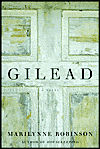
2005: Gilead by Marilynne Robinson - Marg's Review

In 1956, toward the end of Reverend John Ames's life, he begins a letter to his young son, an account of himself and his forebears. Ames is the son of an Iowan preacher and the grandson of a minister who, as a young man in Maine, saw a vision of Christ bound in chains and came west to Kansas to fight for abolition: He "preached men into the Civil War," then, at age fifty, became a chaplain in the Union Army, losing his right eye in battle. Reverend Ames writes to his son about the tension between his father--an ardent pacifist--and his grandfather, whose pistol and bloody shirts, concealed in an army blanket, may be relics from the fight between the abolitionists and those settlers who wanted to vote Kansas into the union as a slave state. And he tells a story of the sacred bonds between fathers and sons, which are tested in his tender and strained relationship with his namesake, John Ames Boughton, his best friend's wayward son.

This is also the tale of another remarkable vision--not a corporeal vision of God but the vision of life as a wondrously strange creation. It tells how wisdom was forged in Ames's soul during his solitary life, and how history lives through generations, pervasively present even when betrayed and forgotten.


Winner of the 2005 Pulitzer Prize, this book is not a book that you read if you want fast moving action. Ostensibly a letter to his young son, it is also a study of the faith of John Ames, particularly in the context of the relationships he had with his family, his parishioners, his best friend, and his namesake who is the rebellious younger son of his friend.

I particularly enjoyed reading of the struggles as John Ames tried to learn how to communicate with his namesake Jack Boughton. Jack is a man who never fitted in anywhere, even in his own family, and the persistence between the two to try and get to understand each other.

The writing is beautiful, and I am sure will touch many people, but for me, I think that this was not the kind of book that I needed to read at this particular moment. It was just too introspective I guess. There were magical moments scattered throughout though. An incident that happened in the late 1800's involving a horse getting stuck in a collapsing tunnel had me laughing out loud on the train, and the ending had me tearing up, once again on the train!

The reason why I read this book now is because it is this month's book in a group I read in. It's interesting looking at the dynamics of the group and seeing who enjoyed it compared to those who didn't. The discussion with this particular book tends to make the reading experience for me! So the rating below reflects my own personal reaction - I might review it later once others add their interpretation and I get extra insights!!

Rating 3.5/5

2007: The Road by Cormac McCarthy - Marg's review

A searing, post apocalyptic novel destined to become Cormac McCarthy’s masterpiece.

A father and his son walk alone through burned America. Nothing moves in the ravaged landscape save the ash on the wind. It is cold enough to crack stones, and when the snow falls it is gray. The sky is dark. Their destination is the coast, although they don’t know what, if anything, awaits them there. They have nothing; just a pistol to defend themselves against the lawless bands that stalk the road, the clothes they are wearing, a cart of scavenged food—and each other.

The Road is the profoundly moving story of a journey. It boldly imagines a future in which no hope remains, but in which the father and his son, “each the other’s world entire,” are sustained by love. Awesome in the totality of its vision, it is an unflinching meditation on the worst and the best that we are capable of: ultimate destructiveness, desperate tenacity, and the tenderness that keeps two people alive in the face of total devastation.


I'm pretty sure that I have mentioned here before that I used to be a regular over in the Oprah book clubs, and I know several people who are now bloggers from those groups. Reading with those groups gave me a much greater understanding of books like One Hundred Years of Solitude. Now when a new Oprah book is announced I add it to my TBR list, with the intention of joining in on the discussions on the boards. With the announcement of The Road by Cormac McCarthy, I did get around to reading it, but I never did really get around to discussing on the boards.

Reading this book wasn't easy. Given the whole post apocalyptic setting, the environment is bleak, the story itself is bleak, the language is sparse. Despite the fact that it is never clear what happened to the world, it is clear that it was an event that affected both men and the natural world.

A man and his young son are travelling the road, trying to walk to the coast where they hope to find something different. There is very little interaction between the pair and other humans, mainly because it is difficult to trust anyone. There are gangs of armed people who will pretty much kill anyone they find...in some cases as a way to provide food. The man is always very wary whenever there are signs of humans, even if the person is travelling by themselves, always teaching his young son that you have to be careful who you trust.

The man tells the boy that he is carrying the light and that they are the good guys, and the young boy struggles to understand how they can be carrying the light when they are guilty of many of the things that the father says the bad people do.

As they travel along the road, close to suffering starvation, the father despairs of how to provide for his son, especially as they both suffer illness. Each time they come to a town or isolated home, a search is done through the houses and shops to see what others who have been there before them may have left behind, luckily stumbling on a couple of caches of food that help sustain them.

Upon reaching the coast though...they basically find nothing, and they will have to keep travelling.

It is a bleak story, full of griminess and at times hopelessness, but it is definitely well written, and I can definitely see why the book won the Pulitzer. The relationship between the father and the son is complex, but also compelling in its depth and closeness.

I am not sure that reading this book has inspired me to go and read more by McCarthy, although I am sure I will get to him again eventually!


This review was originally posted on my blog in May 2007.

Monday, January 14, 2008

Observation about first 8 winners, or my quick update

I posted on the first winner, His Family, (on Dabbling Dilettante) back in June. Then I posted on the fifth in September which was One of Ours. Now I'm on the eighth, Arrowsmith by Sinclair Lewis. So, I've been a little bit sporadic.

Here's what I can tell you so far: Out of the first eight books, six of them take place in the midwest. Two in New York. Interesting, I think. And it looks like the ninth, Early Autumn by Louis Bromfield might, too. And almost all deal with the characters coming to grips with the social, geographic, economic, civic changes of the late 19th century. This is understandable. They went from horses to cars in a matter of a few years, city and town layouts changed, the way people lived and worked and where they lived changed, etc. But why such a focus on the midwest?

First of all, most of the authors are from that part of the country:

1918 His Family by Ernest Poole: from Chicago but this book takes place and is all about a changing turn-of-the-century New York

1919 The Magnificent Ambersons by Booth Tarkington: from Indianapolis; Indiana is important in much of his work--This book takes place in Indianapolis though not named

1920 (No Award)

1921 The Age of Innocence by Edith Wharton: New Yorker, born and bred

1922 Alice Adams by Booth Tarkington: takes place in midwest: see above

1923 One of Ours by Willa Cather: born in Virginia but moved with her family to Nebraska as a child; well-known for Nebraska works such as My Antonia--This book takes place in Nebraska

1924 The Able McLaughlins by Margaret Wilson born in Iowa--book takes place in Iowa

1925 So Big by Edna Ferber born in Michigan, lived in Wisconsin--book takes place in and around Chicago

1926 Arrowsmith by Sinclair Lewis born in Minnesota--book takes place in a fictional place called Zenith, Winnemac, near Illinois.

1927 Early Autumn by Louis Bromfield from Ohio, defined as a Midwestern-American writer--not sure where book takes place as I haven't gotten there yet, but I'm thinking midwest.

Just an observation so far. Reading chronologically gets you looking for patterns, I guess.

Saturday, January 12, 2008

New to the Project

Hi, my name is Marg, and I usually blog over at Reading Adventures.

I first put my post to join this challenge in draft on my blog a good three months ago, but finally today actually posted it and signed up to join in. Of the list I have read the following:

2007 - The Road by Cormac McCarthy
2006 - March by Geraldine Brooks
2005 - Gilead by Marilynne Robinson
2003 - Middlesex by Jeffrey Eugenides
1992 - A Thousand Acres by Jane Smiley
1986 - Lonesome Dove by Larry McMurtry
1961 - To Kill a Mockingbird by Harper Lee
1937 - Gone With the Wind by Margaret Mitchell
1932 - The Good Earth by Pearl Buck
1921 - The Age of Innocence by Edith Wharton

In the next few months I am hoping to read (or reread as the case may be):

2006 - March by Geraldine Brooks
2004 - The Known World by Edward P Jones
2002 - Empire Falls by Richard Russo


I look forward to participating with you all.

Friday, January 4, 2008

The Magnificent Ambersons by Booth Tarkington, 1919

This is the story of the fall from social prominence of a “Midland” family around the turn of the 20th century. Due to the financial success through land and investments of Major Amberson, the patriarch of the family, the Ambersons achieved social prominence in one generation. The story is primarily concerned with the abrupt decline of that family in the 3rd generation, as experienced by Major Amberson’s only grandchild, George Amberson Minafer. An arrogant and self-absorbed child who keeps those less-than-endearing personality traits into adulthood, George is the embodiment of the selfish, narcissistic “dandy”; his life goal is not “to do”—any sort of work or profession is beneath him and his self-perceived status—but “to be”—a gentleman.

But coming along to upset almost everyone’s ideas of society and progress is the automobile, its disruptive force personified of one of its (fictional) pioneers, Eugene Morgan. A former resident of the town as well as a former suitor of George’s mother, Isabel, Morgan invokes uneasiness in George, who proceeds to fall in love with Morgan’s daughter, Lucy.. That uneasiness turns to hatred when George’s is unaccustomedly denied something he wants and has his superficial values of life rejected. The result is tragic.

The automobile, however, is more than just an irritant for George, an unacceptable way for Morgan to make a living. It represents enormous economic and social upheaval, as wealth shifts from the American equivalent of the landed gentry to the new industrialists and speculators. The mobility provided by the automobile drastically alters the landscapes of urban areas; the Midland town—a mall puddle in which the Ambersons are large frogs—becomes a large city, whose growth in unchecked, leaving the Ambersons and their old-fashioned ideas of society behind; the Ambersons literally vanish in the sprawl of a large industrialized city.

In 1919, when Tarkington wrote the book, there was nothing remotely approaching an “environmental movement”. Yet Tarkington, in vivid prose, describes the price of the automobile and the resulting unrestricted growth, both in cities and in industry: soot-filled air from soft coal-fired furnaces of factories; disappearance of farm land as the city “upheaves” and moves its boundaries further and further out; the disintegration of the old pioneer values that had held sway for nearly 100 years only to be replaced by those of untrammeled greed; the destruction of neighborhoods as families are displaced by apartment dwellers and those living next to one another hardly ever meet. The Magnificent Ambersons is prophetic.

These forces destroy George’s world, so affectionately described at the opening of the book. But Tarkington doesn’t lay the blame solely on outside forces; instead, he makes very clear the negative impact of a doting mother and grandfather, who give George everything he wants and treat him like a god, an indifferent father who cares only for his business, and a group of fawning companions and similarly afflicted spoiled colleagues at university. George is not a bad person, but his self-absorption, his mania about preserving the “family name” as a reflection off his own self-important social status, is a recipe for disaster for those closest to him. The language may seem stilted, more suited to the post-Victorian era which it portrays (the story ends before the start of World War I), but the story is immortal; it can be seen played out in today’s media by the society celebrities of this age.

The Magnificent Ambersons is a morality tale with obvious lessons. George, a sinner, is suitably punished but earns redemption. While the language of the Victorian Age may present a bit of a problem and personal behavior may stretch the credulity of an early 21st century reader, the story is told poignantly, with great clarity, and to enormous effect.

Sunday, December 30, 2007

The Hours - 3M's Review

mrsdalloway.JPGhours.jpg
I originally did a "twin" review of this on my blog. I had seen both of these movies before I read the books, and I recently re-watched The Hours because it was available for online viewing through Netflix. I'd like to watch Mrs. Dalloway again as well. The movie of the The Hours follows the book very closely-there are a few minor changes. Nicole Kidman does an outstanding job in this film. I was most interested in the Virginia Woolf storyline, so I was happy she was so well portrayed. It's funny that Meryl Streep ended up playing Clarissa when she (Meryl Streep) is actually talked about in The Hours (the book). I don't remember the movie Mrs. Dalloway much at all, hence the reason I wish to re-view it.

Well, on to the books. The Hours won the Pulitzer in 1999. It's a cleverly told story that intersects the 3 women's lives very well. However, it does change the story of Mrs. Dalloway into homos*xual relationships. It was interesting to see the twist in the storyline, particularly if you know the real one, but I couldn't help thinking, "Doesn't Clarissa (in The Hours) know that her life is too coincidental with the characters' names from Mrs. Dalloway?" To me, it would have been a better story if Cunningham had left out all the references to the actual book itself. The reader knows that's what it's about, so why keep referring to it? It makes The Hours too unbelievable. It's an interesting book, and I'm glad I read it, but I can't help having mixed feelings about it.

Mrs. Dalloway. I must be too dense in the literary sense, because I just don't get this book at all. I had to stop reading it every half hour because it was just too much otherwise. I felt a similar way this year when I read Inheritance of Loss. I just don't enjoy a book when I have to read it that way. I don't get into planning parties or the minute details of such. In fact, I avoid that like the plague. I'm not into social scenes, either. In this book, everyone loves Clarissa, but isn't she the most shallow character in it? I don't get it. I would like to re-read it again in a few years to see if I feel any differently. At least I feel more enlightened that I have finally read Woolf. I'd actually like to read more about her than by her.

For The Hours:
1998, 226 pp.
Rating: 3.5
Pulitzer, 1999


For Mrs. Dalloway:
1925, 194 pp.
Rating: 3

J.C. Montgomery: Progress and 2008 Goals

I know I got a jump on my 2008 list, but I just couldn't help myself. Actually, its all my son's fault. He found out how much I wanted to read To Kill A Mockingbird, so he dug through his bookcase and gave me his so I could start right away. He was very proud of himself for remembering he had it, and insisted I keep it. I just couldn't let him down.

Progress to date:
1961 - To Kill A Mockingbird by Harper Lee

2008 Reading List:
1939 - The Yearling by Marjorie Rawlings
1940 - The Grapes of Wrath by John Steinbeck
1966 - Collected Stories by Katherine Anne Porter
1983 - The Color Purple by Alice Walker
1988 - Beloved by Toni Morrison
1995 - The Stone Diaries by Carol Shields
1998 - American Pastoral by Philip Roth
2004 - The Known World by Edward P. Jones

Saturday, December 29, 2007

Amanda's 2008 Goals

I am new to The Pulitzer Project and will begin in 2008. I read a few of these books in high school or college English classes, but I want to read them again so I am starting with a clean slate. My goal is to read at least 8 Pulitzer Prize winning novels in 2008.

Here's my list:
2007 - The Road (McCarthy)
2006 - March (Brooks)
2003 - Middlesex (Eugenides)
2002 - Empire Falls (Russo)
2001 - The Amazing Adventures of Kavalier & Clay (Chabon)
2000 - Interpreter of Maladies (Lahiri)
1999 - The Hours (Cunningham)
1961 - To Kill a Mockingbird (Lee)

To Kill A Mockingbird by Harper Lee 1961

Winner of the 1961 Pulitzer Prize for Literature, Fiction, 336 pages

Initially, I was introduced to Harper Lee’s novel through the 1962 movie starring Gregory Peck. However, I had never read the book. As I wanted this reading to be as fresh as possible, I made it a point not to read anything about the book: reviews, criticisms – nothing. I wanted any impressions made, to be my own.

For me, the reason this book is deserving of the honor of a Pulitzer Prize, is the fact that Miss Lee has created a story which not only projects a strong theme of ethics and morals, but also contains subtle undercurrents of courage, loss of innocence, and prejudice (of class as well as race), which she has woven brilliantly throughout the narrative.

To Kill A Mockingbird is separated into two parts, yet they work together to illustrate the consequences of ignorance and prejudice, as well as the power of dignity and courage.

Sometimes the right choice is the hardest, and does not always lead to victory. Courage is being able to face the inevitable, even if you know from the beginning, it is a losing one. Here is where Miss Lee’s brilliance shines. It is not enough to have a parent as a role model; she has each child learn this harsh truth through personal experiences. In one of the more poignant passages in the book, Atticus explains to Jem what real courage is, “I wanted you to see what real courage is, instead of getting the idea that courage is a man with a gun in his hand. It’s when you know you’re licked before you begin but you begin anyway and you see it through no matter what.” (121)

One thing that surprised me the most about this book was the amount of controversy surrounding it, even to this day. But the reader must remember that within the setting and tone of the novel, it is appropriate – and I would say absolutely necessary. How can one truly understand 1935 Alabama unless one gets into the mindset of its people and the harshness of its environment?

It was not a politically correct period in American History; therefore politically correct sensibilities must be set aside when reading this book. In this novel, as in life, the goodness of men is always tempered with its opposite. The simple fact is that human nature is made up of the capacity to be ultimately kind or horrifyingly evil. But when the evil in us is faced with dignity, grace, and courage, it can be overcome.

I give this book 5 stars with the simple advisement that one take into consideration the language and subject matter and rise above it, for its message is much more important than the words used to convey it.

My full review can be found here.

Friday, December 28, 2007

Ex Libris: New to Project - Progress and 2008 List

Reading the Pulitzer winners is something I have been wanting to do for a long time. I've read several of these authors but not their Pulitzer Prize winning books! This project is a great idea and a non-threatening way of reading through this list. Thanks, 3M!

My progress to date:

2006 - March by Geraldine Brooks
1961 - To Kill A Mockingbird by Harper Lee
1937 - Gone With the Wind by Margaret Mitchell
1919 - The Magnificent Ambersons by Booth Tarkington

2008 Reading List:

2000 - Interpreter of Maladies by Jhumpa Lahiri
1995 - The Stone Diaries by Carol Shields
1988 - Beloved by Toni Morrison
1972 - Angle of Repose by Wallace Stegner
1938 - The Late George Apley by John P. Marquand
1928 - The Bridge of San Luis Rey by Thornton Wilder

Sharon

Monday, December 24, 2007

The Bridge of San Luis Rey - Wendy's Review

Some say that we shall never know and that to the gods we are like the flies that the boys kill on a summer day, and some say, on the contrary, that the very sparrows do not lose a feather that has not been brushed away by the finger of God. - From The Bridge of San Luis Rey, page 9 -

Thornton Wilder earned the Pulitzer Prize in 1928 for The Bridge of San Luis Rey, which has been called his masterpiece. The novella (only 107 pages) begins in the summer of 1714 when a bridge of great construction fails and plunges five people to their deaths in the gorge below. A witness to the tragedy, Brother Juniper, embarks on a quest to prove divine intervention by exploring (in great depth) the lives of the people killed.

The book is essentially a lesson in philosophy - exploring the meaning of love, the twists and turns of one's life amid the greater scheme of things, and whether death is fate or God's plan. There are not any real answers to any of the questions - just the questions.

Wilder writes in old fashioned language and the novella is set in a foreign country with all the subtle references to politics and religion of the time. I admit to getting dragged down in it all and struggled to slog through and finish the book.

Wilder's character development is one of the strengths of the book; and Wilder does this within a very few pages which speaks to his gift as a writer. My favorite characters were the twins Esteban and Manual and I think Wilder does an apt job of presenting their relationship to each other and the devastation of loss that occurs between them. Wilder connects all the central characters to each other...something that took me by surprise...sort of like the six degrees of separation theory. Because of this I expected a resolution to the ultimate question: Could it have been fate that plunged these people to their deaths? Or something larger? But, Wilder apparently never intended to provide an answer. In the afterword of the book I read, the publisher shares a letter from Wilder to one of his readers:

'The book is not supposed to solve. A vague comfort is supposed to hover above the unanswered questions, but it is not a theorem with its Q.E.D. The book is supposed to be as puzzling and distressing as the news that five of your friends died in an automobile accident.'

Perhaps had this been a non fiction philosophy text, I could accept Wilder's cop out on this issue. But, this is a work of fiction and I wanted the character of Brother Juniper to at least come to his own conclusion. Instead, the reader is left with an odd feeling of detachment.

Because this has been touted as a great work of literature, I wanted not only to like it, but to "get it." I'm sorry to say, neither of those things happened.

Not recommended; rated a generous 3/5.

Saturday, December 15, 2007

The Shipping News - 3M's Review

shippingnews.JPGI started out not liking the writing style of this book at all. This is the first Proulx book I've read, but if her other books are written in the same style, she is the queen of both the sentence fragment and the comma splice. I get that some of the sentences were supposed to be news headlines, and I found that to be clever. However, not all of them were and it truly was like fingers on a chalkboard to me. After a few chapters, though, I found the storyline very compelling. The characters were well drawn, and I was sympathetic to their life situations. I discovered that I wanted to keep reading so I could learn what happened to them.

Quoyle and his family go from the States back to Newfoundland, which is where his father was originally from. Everyone there knows about the Quoyles and it isn't all good. Quoyle is a kind man, but a bit of a bumbler, or so he thinks. He has a job at the local newspaper writing about car wrecks and the shipping news. (I could have done without the detailed newspaper reports of the s*x abu se cases.) He takes care of his little girls, Bunny and Sunshine, as well as his aunt. Or is his aunt taking care of him? (I was fascinated by her character, especially the certain incident with the outhouse!) All in all, it's an engaging domestic drama taking place in a freezing, unforgiving climate.

In the end, I still didn't like the writing style, but I did enjoy reading about this family and Newfoundland. I'm now looking forward to viewing the movie adaptation.

1993, 337 pp.
Rating: 3.5


Winner, Pulitzer Prize
Winner, National Book Award

Saturday, December 8, 2007

Jill's Progress and 2008 Goals

Thanks to 3M for hosting this challenge - here's my progress so far!


Pulitzers Completed For This Challenge
1. 2005 Gilead by Marilynne Robinson
2. 2003 Middlesex by Jeffrey Eugenides
3. 2002 Empire Falls by Richard Russo
4. 1999 The Hours by Michael Cunningham
5. 1953 The Old Man and the Sea by Ernest Hemingway
6. 1939 The Yearling by Marjorie Rawlings

For 2008, I am challenging myself to read 10 more Pulitzer Prize winners:

1. 2007 TBD
2. 2006 March by Geraldine Brooks
3. 2004 The Known World by Edward P. Jones
4. 2001 The Amazing Adventures of Kavalier and Clay by Michael Chabon
5. 2000 Interpreter of Maladies by Jhumpa Lahiri
6. 1994 The Shipping News by Annie Proulx
7. 1986 Lonesome Dove by Larry McMurtry
8. 1981 The Confederacy of Dunces by John Kennedy Toole
9. 1973 The Optimist’s Daughter by Eudora Welty
10.1947 All The King’s Men by Robert Penn Warren

Thursday, November 29, 2007

The Good Earth - Wendy's Review

Moving together in perfect rhythm, without a word, hour after hour, he fell into a union with her which took the pain from his labor. He had no articulate thought of anything; there was only this perfect sympathy of movement, of turning this earth of theirs over and over to the sun, this earth which formed their home and fed their bodies and made their gods. The earth lay rich and dark, and fell apart lightly under the points of their hoes. Sometimes they turned up a bit of brick, a splinter of wood. It was nothing. Some time, in some age, bodies of men and women had been buried there, houses had stood there, had fallen, and gone back into the earth. So would also their house, some time, return to earth, their bodies also. Each had his turn at this earth. They worked on, moving together - together - producing the fruit of this earth - speechless in their movement together. -From The Good Earth, page 31-

Pearl Buck's novel The Good Earth was published in 1931 and won a Pulitzer Prize in 1932. It has been surrounded by controversy (mostly in China where Buck's work was banned for many years because of the perceived vilification of the Chinese people and their leaders). Having arrived in China as the child of missionaries, Buck grew to love the country. In 1935 she returned to the United States with hope of one day returning to the Orient...but this was never to be. She was denounced by the Chinese government in 1960 as "a proponent of American cultural imperialism." Later, just nine months before her death, her visa to return to the country of her childhood was denied. In 1938 she became the first American woman to win the Nobel Prize for literature. More about Buck's life and work can be found in this excellent article published by Mike Meyer of the New York Times.

The Good Earth is the saga of Wang Lung, who is a poor farmer dependent on the land for his survival, and his extended family. The novel begins with this complex character as a young man when he marries a slave girl, and then follows him as he grows into a man with a family and wealth beyond his imaginings. Wang Lung is a man with a compassionate heart. I was touched by the love of his children, especially that of his developmentally delayed oldest daughter who he calls "the poor fool." In one scene, the family is faced with starvation and Wang Lung gives up his own food for his daughter...something that would have been highly unusual at that time in China.

Only a few of the beans did Wang Lung hide in his own hand and these he put into his own mouth and he chewed them into a soft pulp and then putting his lips to the lips of his daughter he pushed into her mouth the food, and watching her small lips move, he felt himself fed. -From The Good Earth, page 85-

Later, as he gains wealth, Wang Lung loses his path - and his inner goodness is challenged.

Wang Lung's pragmatic wife O-Lan represents the strength of the Chinese women during a time when women were considered to be a man's possession and slave. Throughout the novel, the idea of the cyclical nature of life is repeated, establishing a natural rhythm for the story.

Buck writes in simple prose which reads more like the oral tradition of story telling than a novel. Her understanding of character is evident throughout - and no character is all good or all evil.

I immediately was captivated by Buck's story; and even though at times the abuse and mistreatment of women was hard to read, I found I could not put the book down for long.

Buck wrote two sequels to The Good Earth: Sons (1931) and A House Divided (1935). I have put both on my wish list for future reading.

The Good Earth is a book I can highly recommend for its insight into Chinese culture during the early part of the 20th century, and for its high readability. Rated 4.5/5; my original review here.

Sunday, November 25, 2007

The Road, reviewed by raidergirl3

I finished this a month ago, but forgot to post anything here. Originally posted at my blog here


The Road by Cormac McCarthy
Pulitzer Winner 2007

I finished. I still have the little pit or knot in my stomach that I had during the whole reading. I can see why this book won the Pulitzer Prize for literature this year, and why it was an Oprah pick, with her usual depressing and dreary themes. But that makes it sound like I didn't like it, and I did, I liked it a lot.

I've been reading reviews of this book all year, and I know a lot of people have already read this book. So I knew about the strange punctuation and didn't notice it because I had been warned. In fact, in dewey's review at the nyt notable book review blog, she made an excellent analysis about how the level of discussion and punctuation varied directly with the hunger of the main characters.

Plot outline: A man and his son, never named, are travelling and surviving in a post apocalyptic America, summarized wonderfully by someone somewhere (I can't find who) as ash,ash,ash, forage,forage,forage, and then more ash, forage, sleep. This was very bleak, colorless, and depressing, and I just kept thinking: What would I do? How could people survive? Would you want to? And yet, I kept picking this back up, and I read it fairly quickly, in a few days. And every time, I was immediately transported to this terrible world, with 'bad guys' and cannibals, and fear, and survival. The father is doing everything he can, to survive and protect his son.

A few thoughts and questions:

- Plastic is not all bad, since it was one of the only things to survive. If there hadn't been plastic items for them to scavenge, they would not have found much
- What have the father and son been doing for all the years since the son was born? Have they been walking all this time? Have they met nobody safe in all this time?
- What happened to all the bullets in the gun? Because there was more than one, I believe, at some point.
- But there has to be more religious overtones to the story, because of the apocalypse ending of the world. How does God, and religion, continue in a world like that? Is there a place/need for it? And I think the book shows there is a need, we need to trust people, and good will triumph.

The Hours reviewed by raidergirl3

The Hours by Michael Cunningham

Pulitzer Winner 1999

Three parallel lives are followed through a single day in each life: Mrs Brown, a 1950s housewife who is reading Mrs Dalloway; Clarissa, known as Mrs Dalloway who is living the life, in present day New York, from Mrs Dalloway, the novel; and Mrs Woolf, the author who is writing Mrs Dalloway in 1920s England. Hmm, perhaps I should have read Mrs Dalloway first? I'm pretty sure I missed a lot of the symbolism and parallels that connect this book to Mrs Dalloway. While I usually firmly believe in reading the book first, in this case I think the movie would stand alone better than the book. Now I need to see the movie and see if I am right.

Themes of suicide are throughout; the prologue details the author Virginia Woolf's drowning suicide, Mrs Brown is contemplating it as a means of escaping the life she feels trapped in, and Clarissa deals with the death of a friend. I read about other themes and important symbols at the Sparks notes site. This novel will be discussed at Bookawards Yahoo Group during the month of December and I expect to discover some interesting ideas and themes during that discussion.

However, any book of only 225 pages that takes me over a week to read must have some problems. I didn't connect enough with the story and the characters because it was so busy being important, with symbols and parallels. Not to say that I wasn't interested, because I did want to see how all three stories connected in the end and I would like to read Mrs Dalloway, I think, if only to see where this book came from. But overall, this book was just an okay read, nothing wrong, just not a book that I will rave about or remember too much from. I applaud the author's ambition, and with enough prior knowledge and background, I think I would have enjoyed it more. But there was no prerequisite listed on the cover, and I think there should be.

also posted at my blog

The Old Man and the Sea by Ernest Hemingway

The Old Man and the Sea
By Ernest Hemingway
Completed November 24, 2007


Hemingway was always an author I wanted to tackle, so I decided to start "small" and go with The Old Man and the Sea. Overall, I enjoyed this novella and appreciated this story of perseverance and sheer will.

The Old Man has not caught a fish in months. Encouraged by The Boy, he decided to go far out into the sea, sure that his luck must soon take a turn for the better. The Old Man was right and snarls an 18-foot marlin. By himself, The Old Man must wait for the marlin to tire out before he can bring the fish to shore. The marlin and the Old Man start a cat-and-mouse game of who's going to last the longest.

I was fascinated with the way this story was written - it was mostly a narrative with very little dialogue. Less gifted writers could not have pulled this off, but Hemingway did beautifully.

Am I ready for more Hemingway? The Old Man and the Sea has definitely made me more confident. In any case, I am glad to have read this delightful little story. ( )

(Cross-posted from my blog)

Sunday, November 11, 2007

Empire Falls by Richard Russo

Empire Falls
By Richard Russo
Completed November 11, 2007


Having finished Empire Falls, I have been contemplating what exactly to say about it. It was a good book. It was a long book. It was very well-written.

But so what? I could say that about many books.

I think the thing that differentiates Empire Falls from other books is how Richard Russo is a master at character development. Empire Falls is the story of Miles Roby, a forty-something future divorcee who struggles as a manager of a local greasy spoon. Living in small-town Empire Falls, everyone knows his business: that his wife left him for the owner of the local health club, that the wealthy Mrs. Whiting holds Miles's future in the palm of her hand, that his daughter is struggling with high school, that he is a nice guy with a grumpy father, meddlesome town sheriff and enterprising brother. So many characters - but by the time the novel is over, Russo depicts them all completely. You really get to know them over the course of the 500 pages.

Another interesting aspect of Empire Falls is the mini-crescendos that occur throughout the story. Each tiny apex springs up every few chapters, until the last 50 pages when you get the "mack daddy" twist. The plot movement flowed liked a good TV drama, which is probably why HBO decided to adapt this novel into a mini-series.

Overall, I enjoyed Empire Falls, and I look forward to reading more of Richard Russo's other books. ( )

(Cross-posted from my blog)

A Bell for Adano by John Hersey

This is a very American book. It could not have been written by any other nationality. It also could not have been written in any other era, certainly not in today's (2007) post-Vietnam, Iraq-burdened United States.

In a Bell for Adano, Hersey tells the story of the occupation and administration by Allied forces in 1943 of a recently-liberated Sicilian village. The administrator, Major Victor Joppolo, himself Italian-American, is an idealistic young man who earnestly wishes to help the village for all the "right" reasons-- to see justice done but with compassion, to help the villagers practice and see the benefits of democracy, American style--and a very American desire to be liked. He is, as the Prologue asks us to believe,
"a good man".
And we do indeed wind up believing in Joppolo's very American-style goodness.

The village is shattered under the twin effects of over a decade of Fascist rule and the war. Joppolo's desire is to see the town get back on its feet as fast as it can.

So, instead of fast-paced action, we have a series of interwoven vignettes of just how that occurs. Early on, Joppolo discovers that the people of the town are both greiving and outraged over the loss of their 700 year old town bell. During the time just before thre allied invasion, the Fascists had removed the bell to have it melted down to make cannon. The bell was a part of the psyche of the village. It was the one that rang out the hours, it
"told us when to do things, such as eating. It told us when to have the morning egg and when to have pasta and rabbit and when to have wine in the evening."

It was
"the tone that mattered. It soothed all the people of this town. It chided those who were angry, it cheered the unhappy ones, it even laughed with those who were drunk. It was a tone for everybody".

Moved, Joppolo dedicates himself to finding another, suitable bell.

But meantime the bakeries have to reopen, the fishermen must be able to fish again--and food and water must be brought into the village by mule cart.

And there hangs the crisis of the tale. The late 20th century-early 21st century American idolatry of the military does not take into account the common soldier's experience--that most general officers are narrow-minded, rigid egotists who have no business in any sort of position of authority. We meet one such, General Marvin, who bewilders the village by ordering the killing of the mule of a poor carter and forbidding the entry into the village of any carts--all because one cart was in his way as he made his self-important way down the road. Joppolo, in an act of common sense, rescinds the order--and lays the foundation for his own undoing.

And so the story unfolds--of good acts by the major, of whom the village becomes quite fond, of the hard-headed common sense displayed by the cynical Sgt. Borth, of well-intentioned but disastrous acts on the part of 3 drunken M.P.s. Joppolo uses ingenuity and a sound knowledge of the psychology of his countrymen to get things done--while falling in love with one of the beautiful Sicilian young women in the town, who has lost her fiancé in an insane act during the recent invasion.

In the end, Joppolo's common sense is his undoing, and he is removed form the village by order of General Marvin. But not before he sees the replacement bell--a bell for Adano--hung in the bell tower and hears its clear tone ringing out as he makes his way out of the village.

Hersey's simple, direct style conveys beautifully the view that a majority of Americans had of themselves at this time--direct, uncomplicated people with common sense values who knew how to get things done. An idealistic people who really believed in democracy and that The American Way as embodied in American values would work for everyone. Yes, there were stupid people such as General Marvin, and the acts of American soldiers were sometimes embarassing but still, overall, the G.I.s behaved well and sincerely.

That was the rock-solid belief. The truth, as in all wars, no doubt was different, but that's what Americans believed.

It's a gentle book about good but far from perfect people struggling to survive in the aftermath of war--both the conquered and the conquerors. People die but accidentally. The truth was no doubt different, but Hersey's book captured the beliefs and ideals of the American people who had just come through a horrendous war but could still feel compassion for the unwitting victims of that war. The Marshal Plan was probably the perfect embodiment of that spirit and generosity.

It is a book that could not be written today.

5/5 Highly recommended.

Friday, November 2, 2007

Middlesex - Wendy's Book Review

I feel a direct line extending from that girl with her knees steepled beneath the hotel blankets to this person writing now in an Aeron chair. Hers was the duty to live out a mythical life in the actual world, mine to tell about it now. -From Middlesex, page 424-

Jeffrey Eugenides Pulitzer Prize winning masterpiece, Middlesex, is a rich family saga spanning three generations and takes the reader from Greece to Detroit on a whirlwind ride of rich, original language and spot on characterization. The story of Calliope Stephanides - an American born intersex individual with strong Greek heritage - is narrated by Cal...Calliope's adult male counterpart.

Middlesex is a tragic story which is comically portrayed using Greek mythology. Eugenides is a talented writer - his vivid descriptions are filled with the lush sensations of life. The characters who people this wonderful novel are fully developed; their flaws and imperfections revealed even through the names they are given: The Object (Calliope's teenage love interest), Chapter Eleven (Cal's brother), and a vast array of other characters based on mythical stories. Even the title of the book is steeped in symbolism.

Middlesex! Did anybody ever live in a house as strange? As sci-fi? As futuristic and outdated at the same time? A house that was more like communism, better in theory than reality? -From Middlesex, page 258-

The novel is essentially two stories: the history of a Greek family who carries a recessive gene; and the coming of age story of the main character - Calliope. At times it was easy to forget that this huge novel was written by a man. Eugenides wonderful insight into the thoughts of an awkward, self-conscious teenage girl is finely illustrated in this scene in the locker room after a field hockey game:

In front of me girls were entering and exiting the showers. The flashes of nakedness were like shouts going off. A year or so earlier these same girls had been porcelain figurines, gingerly dipping their toes into the disinfectant basin at the public pool. Now they were magnificent creatures. Moving through the humid air, I felt like a snorkeler. On I came, kicking my heavy, padded legs and gaping through the goalie mask at the fantastic underwater life all around me. Sea anemones sprouted from between my classmates' legs. They came in all colors, black, brown, electric yellow, vivid red. higher up, their breasts bobbed like jellyfish, softly pulsing, tipped with stinging pink. Everything was waving int he current, feeding on microscopic plankton, growing bigger by the minute. The shy, plump girls were like sea lions, lurking in the depths. -From Middlesex, page 297-

The novel is an exploration of immigration and the split loyalties that immigrants face. Eugenides parallels this theme with that of identity in general using the pain of adolescence and the confusion of sexual identity as spring boards to delve into the human psyche.

Middlesex is a vividly imaginative novel - epic in its scope and sensitively wrought. It is well deserving of the Pulitzer Prize.

Highly recommended; rated 4.5/5; read my original review here.

Saturday, October 27, 2007

The Hours by Michael Cunningham

The Hours
By Michael Cunningham
Completed October 27, 2007


The Hours is a complex yet succinct look into the lives of three women: Virginia Woolf as she writes Mrs. Dalloway, Clarissa Vaughan as she plans a party for her best friend, Richard, and Laura Brown as she plans a birthday party for her husband. These three women's stories are distinctive and seemingly unrelated, but as the book ends, you are swept into the many parallels and connections of these women's lives.

Without spoiling the ending, I will remark that some of these parallels include lesbianism, suicide, party plannning and Woolf's Mrs. Dalloway. It's an eclectic mix, but if you're familar with Woolf's literature, you will probably connect the dots pretty quickly. Admittedly, I have not read any of Woolf's books, but a quick study of her on Wikipedia was enough for me to fully appreciate what Michael Cunningham was trying to tell in his Pulitzer prize winning story.

The Hours is an interesting women's tale with characters you can empathize with. I feel fortunate to have seen the movie before reading the book, so the talents of Meryl Streep, Julianne Moore, Nicole Kidman and Ed Harris filled my head as I read Cunningham's words. I highly recommend either one, or even better, both the book and movie for an introspective look into the lives of three thought-provoking women. ( )

Friday, October 12, 2007

Laura's Books Read through 2007

Here's my list of books read and ones I'd already identified as "planned reads" for other challenges. Later in the year I'll set a personal goal for 2008.

Books I've Read (with links to reviews where available):
2007 - The Road (MacCarthy)
2003 - Middlesex (Eugenides)
2000 - Interpreter of Maladies (Lahiri)
1995 - The Stone Diaries (Shields)
1994 - The Shipping News (Proulx)
1992 - A Thousand Acres (Smiley)
1988 - Beloved (Morrison)
1973 - The Optimist’s Daughter (Welty)
1961 - To Kill a Mockingbird (Lee)
1940 - The Grapes of Wrath (Steinbeck)
1937 - Gone with the Wind (Mitchell)
1921 - The Age of Innocence (Wharton)

Interpreter of Maladies - Laura's Review


Interpreter of Maladies
Jhumpa Lahiri
193 pages

Reflections: This beautifully-written collection of short stories portrays various “maladies” of the human condition, such as loss, loneliness, and isolation. As the title suggests, Lahiri interprets these maladies for her readers. And she is absolutely brilliant. The emotions raised by each story are so profound, and so deep, that you can't help but feel them at the core of your own being. As with any collection, a few stories stood out:
  • A Temporary Matter – A couple mourns the loss of a stillborn baby, and begins sharing secrets with one another during a power outage. Their grief, and the void between them, is palpable.
  • Sexy – Miranda, an American woman, has an affair with a married Indian man. At the same time, her office mate consoles her cousin in India, whose husband has left her for a young English woman. Miranda meets the cousin on a visit to the US and, while babysitting her son, has a revelation about her own romantic relationship.
  • Mrs. Sen’s – An Indian woman has recently arrived in the US, and provides after-school care for a boy while her husband teaches at a local university. She is isolated and lonely, is afraid to drive a car, and longs for friends and comforts of home.
  • The Third and Final Continent – A young man, educated in London, comes to the US to work at a university. He is recently married, and waiting for his wife’s immigration papers to be processed so she can join him. For six weeks he rents a room from Mrs. Croft, a 103-year-old woman whose daughter visits once a week to deliver food. He contemplates the woman’s infirmity and isolation, as well as his own emotional uncertainty about life as a married man.
After each of these stories, I had to set this book aside and allow the feelings to wash over and through me. Despite this, it was difficult to put down and even more difficult to let go of when finished. A wonderful book, and very deserving of the Pulitzer Prize. ( )
My original review can be found here.

Saturday, October 6, 2007

1919: The Magnificent Ambersons by Booth Tarkington, Sherry's Review

The only other book I've read by Booth Tarkington was Penrod, a story about a mischievous boy growing up around the turn of the century. I remember it as funny and profound upon the subject of boyhood, kind of like Tom Sawyer.

The Magnificent Ambersons, aside from the time period, the early 1900's, and the setting, the American Midwest, is not at all like Penrod. As an under current in the book, Tarkington preaches about the general nastiness and inevitability of urban sprawl and how the automobile and the factory have destroyed community and cleanliness and all that makes life worthwhile. Preaching aside, Mr. Tarkington still manages to tell an engaging story, a sort of family epic, the rise and fall of the Ambersons.

Georgie Amberson Minafer is a spoiled rich brat, reared in luxury and with a sense of entitlement. The Ambersons, George's mother's family, are the center of society in their "Midland town." From the beginning of the novel, the author sets Georgie up for disaster; the entire town is waiting for George Amberson Minafer to get his "come-upance". As George grows up the reckoning is delayed again and again, but the most casual reader must know that George's pride goeth before a fall. George's favorite word for other people, all others who aren't Ambersons, is "riff-raff". His attitude can only and always be described as condescending, even with the young lady with whom he falls in love.

So, The Magnificent Ambersons is first of all a cautionary tale. Pride is destructive. Things change; no one stays on top forever. Fortunes come and go. Only those who are strong, wise, and flexible, and maybe even lucky, can persevere to enjoy the good life.

However, the book is not just a preachy, moralistic fable. It's a picture of life at the turn of the century, of how change affects different personalities. It's a love story about a mother who idolizes her son, and a young man who loves his family pride more than he cares for the woman who is willing to overlook many of his faults and who could have made him happy. And the ending is about forgiveness and hope and the possibility that broken things can be, if not mended, perhaps made new.

I've not seen the Orson Welles movie based on this book, but I plan to do so. After reading the novel, I can see how this books would make a great "old movie". No modern remakes, however, nowadays a writer and director would most likely ruin the movie version with gratuitous sex and a plot in which only the characters' names were borrowed from the original book.

A Work in Progress review of The Magnificent Ambersons.

The Known World - 3M's Review

knownworld.JPGThe Known World by Edward P. Jones has not only won the Pulitzer Prize for Fiction, but also the NBCC Award and the International IMPAC Dublin Literary Award.

Jones really knows how to write his characters. Each one was very clearly defined. I won't give away too much of the story here but will write a brief overview.

Henry and Caldonia Townsend are slave owners who are black themselves. Henry's father had freed himself and his wife, and then later Henry. While Henry was still a slave under William Robbins, he became somewhat of a favorite, and was later instructed by Robbins on how to be a proper slave owner. Henry builds up quite a plantation but then dies unexpectedly. How Caldonia, along with her overseer Moses, runs the plantation afterward forms the rest of the novel.

Several issues are presented in the book. Whites' attitudes towards blacks, both slave and free; the function of "the law;" men's attitudes towards women (and vice versa); and the question of how and why blacks could own slaves themselves.

This is a very well-written book, and I struggled on whether to rate it a 4 or 4.5. There is some content in the book that downgrades it slightly for me. Consider it a very high 4.

2003, 388 pp.

Pulitzer Prize, NBCC Award, IMPAC Award

Rating: 4

The Hours and Mrs. Dalloway

http://theindividualvoice.blogspot.com/2007/10/michael-cunninghams-hours-with-virginia.html


See my review at the above URL.

Saturday, September 29, 2007

Middlesex by Jeffrey Eugenides

Middlesex
By Jeffrey Eugenides
Completed September 29, 2007

I know I am in the minority here, but Middlesex was a huge disappointment for me. We all know the plot - that it's a story about a Greek girl who later discovers that she's actually a boy. The premise is excellent, but the book falls short in so many ways.

Eugenides is a wonderful writer, and he does an excellent job telling a story - too bad it's not the story of Callie but of her grandparents and parents too. You reach the middle of this 500+ page book before Callie is even conceived. However, Callie narrates the whole thing. How would she know such details about her grandparents and parents? She can't - and I think it's a major flaw in the book (not to mention that you have to wait until the middle of the book for Callie to be introduced as a character. Oh sorry, did I say that already? Well, it's worth repeating because it's a major flaw too).

Because half of the book is dedicated to Callie's lineage, I feel his/her character lacks development, which is a huge shame. For me, Callie had the potential to be one of the most interesting characters in modern American literature. Instead, the character falls flat - just like the entire novel.

Middlesex is a Pulitzer prize winner and a recent selection for the Oprah Book Club. Obviously, many people enjoyed this novel. I am sorry that I am not one of them. However, I am more sorry that I wasted a week of my life finishing a book that I now call Middlesucks. ( )

(Cross-posted from my blog)

Wednesday, September 26, 2007

1975:Killer Angels by Michael Shaara

Killer Angels
Michael Shaara

Finished (reread) 9/25/2007

Winner of the 1975 Pulitzer Prize for fiction, Killer Angels is a remarkable work. Within the pages of one book, it manages to recount an excellent history of the Battle of Gettysburg with fictional 'insights' into the minds, thoughts, and actions of several of the major players on both sides.

To deal with the historical aspect: Shaara's account is mostly accurate; those inaccuracies present are unintentional and minor. One inaccuracy that probably has become fixed in the public mind as history is the charge of the 20th Maine down the slopes of Little Round Top, routing the Alabamans and Texans of the last Confederate assault and taking over 400 prisoners. Until Shaara, very little attention was given to Chamberlain and the 20th Maine--just as a part of the desperate struggle for Little Round Top, while acknowledging the incredible bayonet charge that ended the fighting for the left flank of the Union army. In his superb 3 volume narrative history of the Civil War, in the outstanding chapter on Gettysburg (published in 1963), Shelby Foote gives one paragraph to Chamberlain and the 20th Maine, and equal or slightly more space to his counterpart, Col. William Oates of the 15th Alabama. Chamberlain was highly articulate and wrote extensively after the war. From his writings, it is clear that in actuality, Chamberlain was probably the happiest and most "alive" in his life when he was in the thick of fighting. He wrote quite a bit about Little Round Top; as the years went by, his story changed; the movie account is taken from his last reminiscences. No one surviving the war from the 20th Maine, including the then-Captain Spears, recalls Chamberlain ordering the right wheel charge or, for that matter, ordering the charge, period. Chamberlain had ordered the men to fix their bayonets, after which the charge just more or less happened. Chamberlain was not the first to remember things differently as time went by nor would he be the last. However, the excellent movie made from the book has as one of its high points the battle for Little Round Top, and the charge of the 20th Maine as described in the book, not as it really happened, was portrayed brilliantly. It really doesn't matter; the 20th Maine deserved all the glory it received and Chamberlain, who received the Medal of Honor (30 years later!) for his part in the defense of Little Round Top deserved the recognition.

But except for this and a few other details, the history is excellent. Even the maps are among the best I've seen for the summaries of the positions of the armies during the fighting.

So much for the history. What about the characterizations, particularly of Lee, Longstreet and Chamberlain?

Clearly, Shaara depended heavily on the writings of the participants themselves for material for his fictional account of their thoughts and feelings. Lee is a problem; he never wrote anything after the war in terms of memoirs. There are letters, and there are the memories of those who fought under him, and that's it.

Longstreet wrote his memoirs and other articles as well. As part of the losing team, Longstreet wasn't entirely objective about his role, particularly at Gettysburg; there were high-ranking Confederate officers who, after the war, accused Longstreet of losing the battle and thus the war. Longstreet did not help his own cause by joining the Republican Party after the war (Grant was a personal friend), and much, much worse, criticizing Lee. Longsteet's reputation fell into disrepute; Shaara's novel helped resurrect Longstreet into respectablity.

As mentioned above, Chamberlain wrote extensively and articulately. It does appear that Gettysburg in many respects was the emotional high point of his life. He attended every single reunion until the year of his death.

As for the supporting cast, Buford is problematical. A taciturn man, he wrote little. His most recent biographer admitted the difficulty in putting together such a work since Buford left almost no letters; everything has to be based on memories of friends and colleagues. The same is true for Armistead.

Given those restraints, Shaara did an incredible job of "narrating" from the different points of view of, in particular, Lee, Longstreet, and Chamberlain. No one knows what truly goes on in the minds and hearts of another person. Few people are so honest even in their letters and conversations, except under unusual circumstances, to let others into those particular recesses. Thus, whatever is written from a 'point of view' has to be nearly sheer speculation. This is particularly true of such public persons such as Lee, Longstreet, and Chamberlain. Lee wrapped himself in his reserve and retreated into being a Marble Man of history. Longstreet had axes to grind, and Chamberlain clearly was wistful about the war.

Thus Shaara's is a remarkable achievement in making these figures of over 100 years ago come alive and in a thoroughly believable way. You feel Lee's fatigue, his profound belief in God--you're with him as he decides how to handle his subordinates, particularly Stuart-- as he makes the decision for what will be known in history as Pickett's Charge. You're right there with Dutch Longstreet, one of the two modern generals in that war (the other was Sherman) as he agonizes over being asked to throw away his men in impossible attacks when winning alternatives were available. You fight right along with Chamberlain as he assesses his position, thinks about his orders to defend to the last (a question of rhetoric--last man? last bullet? last Reb?), feel his horror when he realizes he has used his younger brother Tom to "plug" a hole in the 20th Maine lines on Little Round Top. These people are no longer just names in a history book but living human beings participating in the bloodiest struggle in American history.

Shaara takes both these aspects--the historical and the personal--and weaves them into a story that is written vividly in a totally compelling manner and that never stops, never even pauses, but keeps on driving to the bitter climax of Pickett's Charge and the brief aftermath.

As a result, he has made the Civil War, once just the province of buffs and re-enactors, easily accessible to everyone. All history should be as well presented as this novel presents the Battle of Gettysburg, a crucial turning point in the climactic power struggle between North and South known as the Civil War.

Sunday, September 23, 2007

First Five Down

My goal in reading all of the Pulitzer prizewinners for Fiction and the Novel was mostly to introduce myself to new writers and works. I like lists but I don't subscribe to the idea that certain lists and prizes mean that those books are the best of the best and all others should be overlooked. Duh. What hardcore reader would think that anyway? That's what annoys me when people say they hate book lists and book prizes. I mean I understand that lists and prizes bring certain books to the forefront and leave others out and then people who want easy suggestions turn to the lists and a lot of good books go unread. So yeah, that argument makes sense. But that doesn't mean that people should go opposite and entirely ignore lists and prizewinners, right? I feel like good readers will search out obscure books and also read popular or classic "canon" works, as desired.

But you know anyway? Some of the early Pulitzers are most certainly obscure. Of the first five, only two were readily available in Borders or Barnes & Noble: The Magnificent Ambersons by Booth Tarkington and The Age of Innocence by Edith Wharton. The first one, His Family by Ernest Poole, I had to order from Dodo Press, a press that reprints out of print works. The fourth and fifth, Alice Adams by Booth Tarkington and One of Ours by Willa Cather, were in the library, and didn't seem like they had much circulation.

Anyway, One of Ours by Willa Cather has made my venture worthwhile. If I stop right now and don't read past the first five books, I'll have reached my goal. I LOVED that book. It was one of those books in which you get so deep into it, you live it. You know the characters so well and then, THEN, the setting entirely changes and you see how the characters interact in situations and locations totally different from where they started out. Sister Carrie is another example like that. This was the only one I've cried over so far, twice. I was sobbing at the end. And now I have a new spark of interest in World War I. Who knew? I have this out from Netflix now.

I read Death Comes for the Archbishop and My Antonia in high school and hated them both, and therefore never cared for Willa Cather. Now, 15 years later, I see her in a whole new light. I can't wait to read The Song of the Lark.

I'm taking a break now, after the first five. I'm reading The Higher Power of Lucky by Susan Patron as the most recent Newbery winner. I might try to read all those in reverse order, most recent to oldest. We'll see.